Democracy under algorithms: how the attention market is fragmenting our shared world
At the end of the Médias en Seine festival (Paris, 15 January 2026), Pierre Louette and Chloé Morin talked about how algorithms are shaping democracy. Noting that political leaders are now following the rules of online platforms more than they set them, they expressed a feeling increasingly shared at a time when debating the negative impact of social platforms in the social sphere is going mainstream.
In substance, if we keep letting machines and their commercial algorithms take our attention, what will be left of our ability to think together and keep our shared values?
The invisible shift in our public space
Public debate has shifted from a space of public debate and regulated traditional media to social networks governed by the economic laws of the "attention economy". Traditional public space is governed by ethical rules for journalism and by administrative regulation (ARCOM in France). In contrast, the social media space is structured by economic laws that aim to maximise time spent on platforms. This move from thoughtful public debate to the attention market has real consequences.
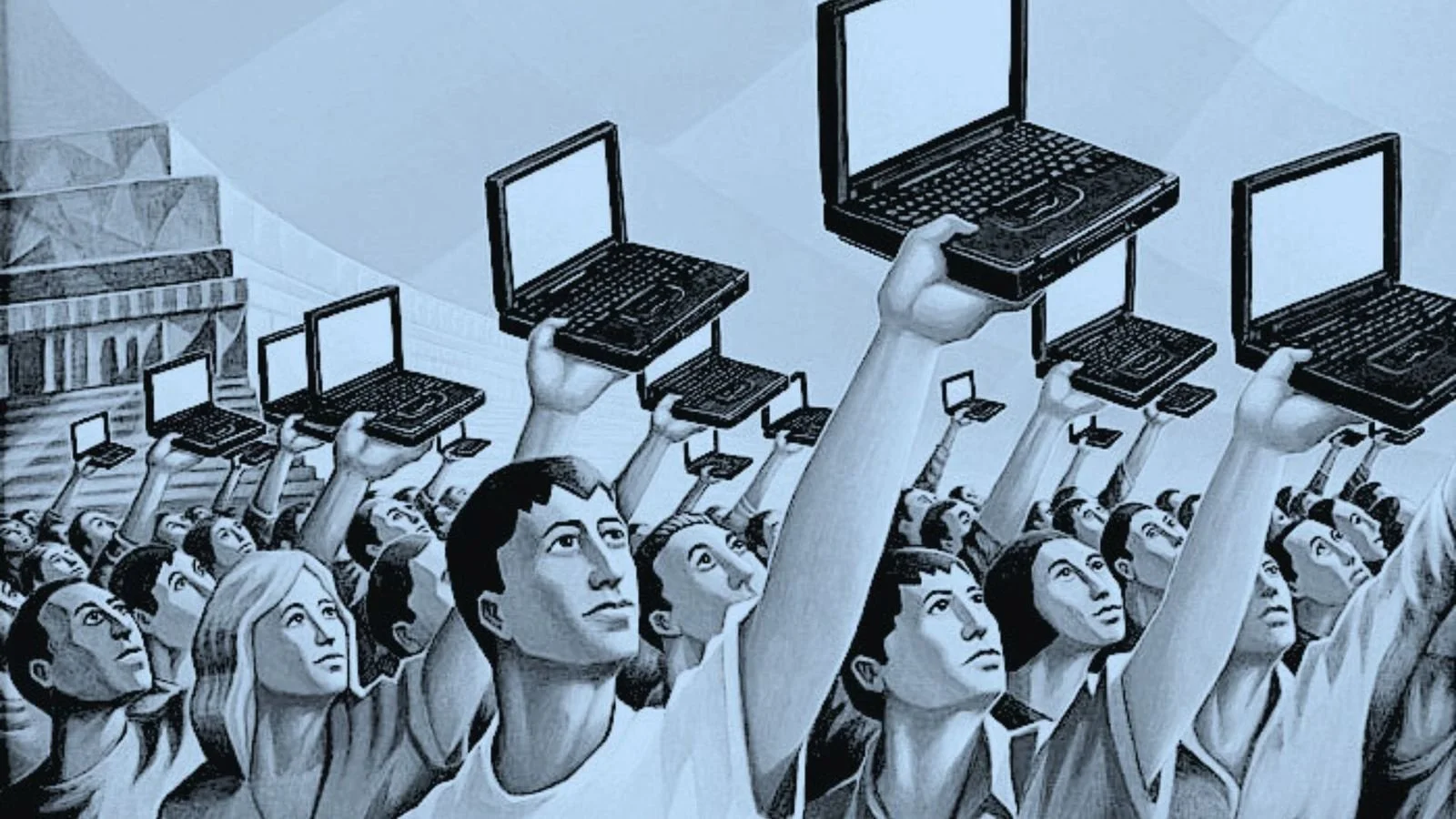
We are losing shared spaces where everyone gathers. Now, people are trapped in narrow online bubbles (”cognitive tunnels”) that reinforce their own views and make opinions more extreme. The shift in our public space fuels social fragmentation. Like a virus, the economic drive behind algorithms has drilled through the democratic layer of the debate, contaminating the exercise of citizenship with mechanisms designed for advertising optimisation. Politicians now use viral tactics like exaggeration and self-mockery, giving up thoughtful discussion for quick reactions.
The economic logic of platforms does not seek to enlighten citizens, but to capture consumers through dopamine rushes. As Chloé Morin analyses, we have shifted from a ‘regime of deliberation’ to a ‘regime of reaction’. On these interfaces, time for reflection is abolished in favour of emotional immediacy.
The end of the common world: From audience crossroads to cognitive tunnels
This capture is a democratic spoliation. Chloé Morin rightly points out that attention is a “common good” that needs to be protected. In a 24-hour day, every minute devoured by an algorithm to maximise stickiness (the rate of screen adherence) is a minute lost to civic life, rigorous information and contradictory debate.
We have left behind the era of ‘audience crossroads,’ those rare moments, such as the death of Brigitte Bardot covered by Paris Match or major sporting victories, when society shares a common narrative. Today, we live in ‘cognitive tunnels.’ Each citizen observes the world from a ‘separate room,’ with their own fragmented stream, losing the “cafeteria” experience of discussing a reality we share.
When messages are aimed at small, targeted communities, people focus more on what separates them from others. By destroying the bridges they are supposed to build between people, politicians become the very instruments of the destruction of the ‘common good’ that they are supposed to uphold.
The logic of platforms dominates. To exist in this stream, politicians adopt a harmful survival strategy: they play the fragmentation, dramatise, caricature themselves, and ‘mimic’ the extremes. They lose control. By addressing micro-communities with micro-messages, they give up on building bridges and actively participate in the breakdown of the national bond.
“It's not more of the same, it's worse of the same. It will always be worse, it will always be more acute to keep you coming back.”
Pierre Louette highlights a crucial nuance and an asymmetry of speed between the true and the false. The machine logic not only offers us “more of the same”, systematically drifting towards the most divisive and acute content, but also prioritises the extreme, often synonymous with falsehood. Pierre Louette reports an undeniable statistic: accurate information takes 7 to 8 times longer to reach 1,000 people than a falsehood.
This ‘fallacious virus’ benefits from optimal circulation because it is designed to shock. The social cost of restoring obvious truths has become exhausting, mobilising considerable resources to counter futile debates. Far from protecting freedom of expression, anonymity acts as a catalyst for trolls and insults, undermining our ability to "build society".
The logic of one-upmanship transforms the central space into a multitude of radicalised factions. It is no longer the search for compromise that prevails, but the stimulation of passion at the expense of reason, making the formation of a political majority increasingly difficult.
Regaining control of our democratic grammar
So, how can we “build a society”, as Louette and Morin ask, “when all the disgusted have left” and “only the disgusting remain”? The diagnosis is unequivocal, and the status quo is no longer acceptable. Both suggest several solutions to regain control of our democratic grammar: “lift the hood” by making algorithms more transparent so to understand how content is promoted, end online anonymity (which they call a 'virus in democracy'), introduce proper media literacy programmes and fighting disinformation with quality labels, and creating rules to protect young people from platforms that try to capture their attention, which they see as a public health issue comparable to a new form of forced labour.
The analogy between the historical exploitation of child labour and the current exploitation of their ‘brain time’ is striking. This is not about stigmatising young people, but about recognising that algorithms monetise a cognitive vulnerability that is still developing. Chloé Morin advocates a ban before the age of 15 or 16, not as a form of censorship, but as a public health measure aimed at protecting the cognitive development necessary for the future exercise of freedom.
The diagnosis does not spare advertisers who avoid political content for fear of damaging their image, while indirectly financing fake news or harmful products such as overly sweetened cereals. They must put an end to their cognitive dissonance.