Davos 2026: The Quiet Comeback of Tokenization adds to Content Provenance in Media
Credit: Shubham Dhage - Unsplash
Over the past three years, ‘AI fever’ has acted as a powerful gravitational well, diverting media attention from the blockchain sector. But as the 2026 World Economic Forum in Davos made clear, this silence was deceptive. While the public was obsessed with LLMs, global finance was engaged in discreet, tedious structural work necessary to move from speculative pilot projects to institutional reality. This reality could serve as a catalyst, lay essential foundations, and create a positive ripple effect for the adoption of a decentralised ledger infrastructure that certifies content provenance and safeguards intellectual property in the media.
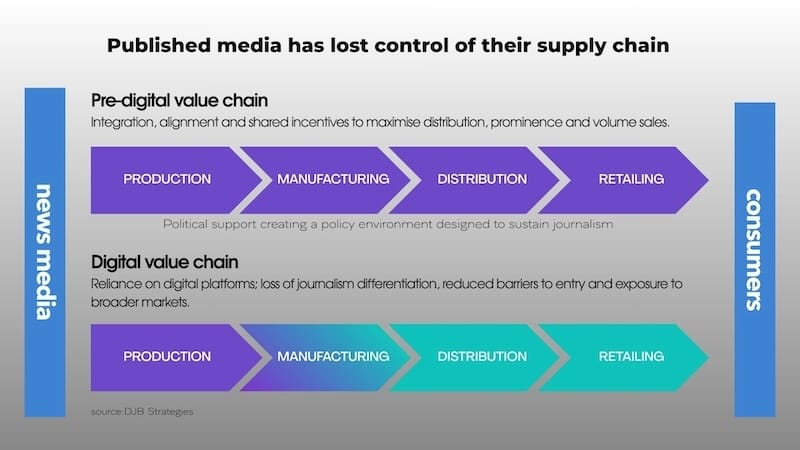
Last week, I had an interesting conversation about how the media and creative industries could protect their content in the future, guarantee its provenance, and, above all, regain control over a value and supply chain that is increasingly slipping from their grasp into the hands of tech intermediaries.
The industry is turning to regulation and political support in the hope that it will solve its problem. It's a necessary, while uncertain prospect. The European regulatory preservation island is under attack from the US administration's repressive measures, and is also being criticised by Europeans themselves. Global alignment and multilateralism are being sacrificed on the altar of national sovereignty, and the ability of strategic alliances between middle powers to restore balance remains to be seen.
Building on these regulatory uncertainties, our conversation shifted to how sector best practices, rooted in shared industry protocols and standards, can instead drive change.
Again, we drew a discouraging conclusion: organisations engage in isolated experimentation, adopt standards narrowly, remain dispersed as players, fail to reach consensus, and generally misunderstand how industrial standards support business prosperity.
The quiet tokenisation of the economy is an essential incentive for adopting content-provenance protocols in media.
Against this backdrop, at Davos 2026, amid debates over deep geopolitical tensions and cracks in American global leadership, many discussions focused on how tokenization has moved from a crypto experiment to a key part of global finance. Institutions, regulators, and governments now see it as essential market infrastructure. Indirectly, they have shed light on a path forward to downweight misinformation and restore trust in the news media, grounded in content provenance.
"Tokenization" is the process of converting rights to an asset - whether physical (real estate, art, or gold), financial (shares or bonds), or intangible (loyalty points, voting rights, access to a service, or data) - into a digital token that exists on a blockchain-based shared ledger. Every token issuance and transfer is recorded in an ordered, tamper-evident chain of blocks. This ensures ownership, transfers, and rules for the tokenised asset are transparent and verifiable by all participants. The blockchain ledger displays who owns what and all previous transfers, which aids in auditability and reducing fraud.
Looking ahead, as tokenization moves into a critical financial market infrastructure, it can signal a similar shift for decentralised content provenance. Platforms and publishers would move from using it as an optional add-on to making it the default plumbing they quietly rely on. If tokenisation becomes commonplace in our monetary and financial systems, it will inevitably spread to all layers of the economy. This is a critical incentive for adopting standards on content provenance and for the fight against misinformation, both of which rely on the same accountable, transparent protocols enabled by shared ledger technologies.
The question is no longer whether tokenization belongs in mainstream finance, but how fast, safely, and inclusively we should implement and distil it into other business layers. A likely scenario is that adoption by the financial community could accelerate its spread, through capillarity and knock-on effect, to advertising, where shared ledgers address critical pain points, and ultimately to news media and content creation.
What tokenization adds to content provenance:
Cryptographic audit trail: Tokenized records or on-chain hashes create an immutable log of content creation and edits, similar to lifecycle histories for tokenized bonds and funds.
Global identifiers and markets: Token-like content identifiers can integrate with decentralized identity and rights systems, enabling verifiable ownership, licensing, and fractional revenue-sharing of media assets.
Interoperability: Open standards like C2PA, along with Verifiable Credentials and Decentralised Identifiers, such as the Global Media Identifier (GMI), provide a shared way for different platforms to verify provenance, much as financial token standards enable assets to move across chains and custodians.
Financial and monetary markets are the bedrock of our economies. Their mainstream adoption of tokenisation is a powerful incentive for large platforms, standards bodies, and regulators to align around protocols such as C2PA and blockchain anchoring. Most professional media would then ship with cryptographically signed provenance manifests by default, just as most securities will gradually have by-default tokenized representations.
If provenance tokens or signed manifests become as standard as HTTPS, platforms and browsers could default to showing provenance “signals” and down‑weighting or flagging unverifiable media. That would not stop all misinformation, but it would make it easier to trust content with strong provenance (e.g., newsrooms' election coverage) and to question orphaned, unsigned media.
For content, the main questions will echo those in finance: who operates the key registries and chains, how decentralised they really are, and how to balance privacy with traceability. A likely outcome is a layered architecture: open standards for identification and certification (C2PA, Decentralised Identifiers or DIDs), multiple public or consortium chains for anchoring, and user‑facing tools that expose provenance simply while keeping the underlying tokenisation infrastructure largely invisible.