Since exiting print production a decade ago, The Independent has achieved sustained annual revenue growth, doubling its total revenue over the past six years. This transformation has been driven by a deliberate shift away from sole reliance on traditional advertising and reader subscriptions toward a diversified portfolio model.
Four core growth pillars have driven this commercial strategy: Independent Studio (Infront Studio), E-commerce, Artificial Intelligence (AI), and Membership Strategy. Together, these four areas now generate nearly half of the publisher’s total revenue.
Key strategic initiatives powering this performance include:
Strategic Brand Expansion: Licensing partnerships for BuzzFeed UK properties (BuzzFeed, HuffPost, Seasoned, and Tasty) and taking over digital operations for The Evening Standard.
Product Innovation (Bulletin): An AI-assisted, human-governed summary app designed to mitigate platform referral declines and serve time-poor consumers.
Social Commerce Pivot: A tactical evolution in e-commerce that drove social commerce revenues to surpass traditional affiliate link content revenue for the first time in September.
Targeted AI Integration: A four-workstream AI strategy encompassing operational efficiencies and user-facing tools, such as the Taboola-powered "Deep Dive," which boosted page dwell time and engagement by up to 10% within days of deployment.
The Four Core Growth Pillars
Philippa Jenkins, Head of Registered Audience, highlights that nearly half of The Independent's overall revenues now come from four primary growth pillars:
Independent Studio & Creator Partnerships: Teaming up with internal talent and external creators (e.g., YouTube channels like ACFC) to produce authentic video and creator-led content, combining creator authenticity with brand trust.
E-Commerce & Social Commerce: Diversifying away from reliance on Google search traffic and traditional affiliate links toward social commerce, which recently overtook traditional content affiliate revenue.
AI & Automation: Using AI to automate newsroom processing tasks, power interactive front-end tools (like the Taboola Deep Dive feature), and drive efficiency.
Membership Strategy: Building direct relationships and recurring revenue with readers.
Rather than operating strictly as a single news title, the business expanded into a one-stop shop for audiences and advertisers by managing digital operations for external brands:
BuzzFeed UK Licensing (April 2024): Ingesting BuzzFeed, HuffPost, Seasoned, and Tasty into its operational fold.
Evening Standard Digital: Taking over the Evening Standard's digital operations to restructure and future-proof the brand.
Pivoting Away from the "Scale Game"
A recurring theme is that the historical publisher strategy of relying on massive referral traffic (the "scale game") is no longer viable due to sudden algorithm and referral landscape shifts. To combat this, The Independent focuses on:
Direct Audience Engagement: Building owned spaces like the dedicated Bulletin app, which delivers fast, summary-style news alongside audio and puzzles.
Distribution Innovation: Meeting audiences on non-traditional social and video platforms through Independent Studio.
Jenkins emphasises the need to be courageous and test fast. Because publishers cannot predict exact market shifts, actively testing new formats and quickly killing or scaling initiatives based on real-time metrics is essential to prevent brand stagnation
Strategic Portfolio Expansion and Operations
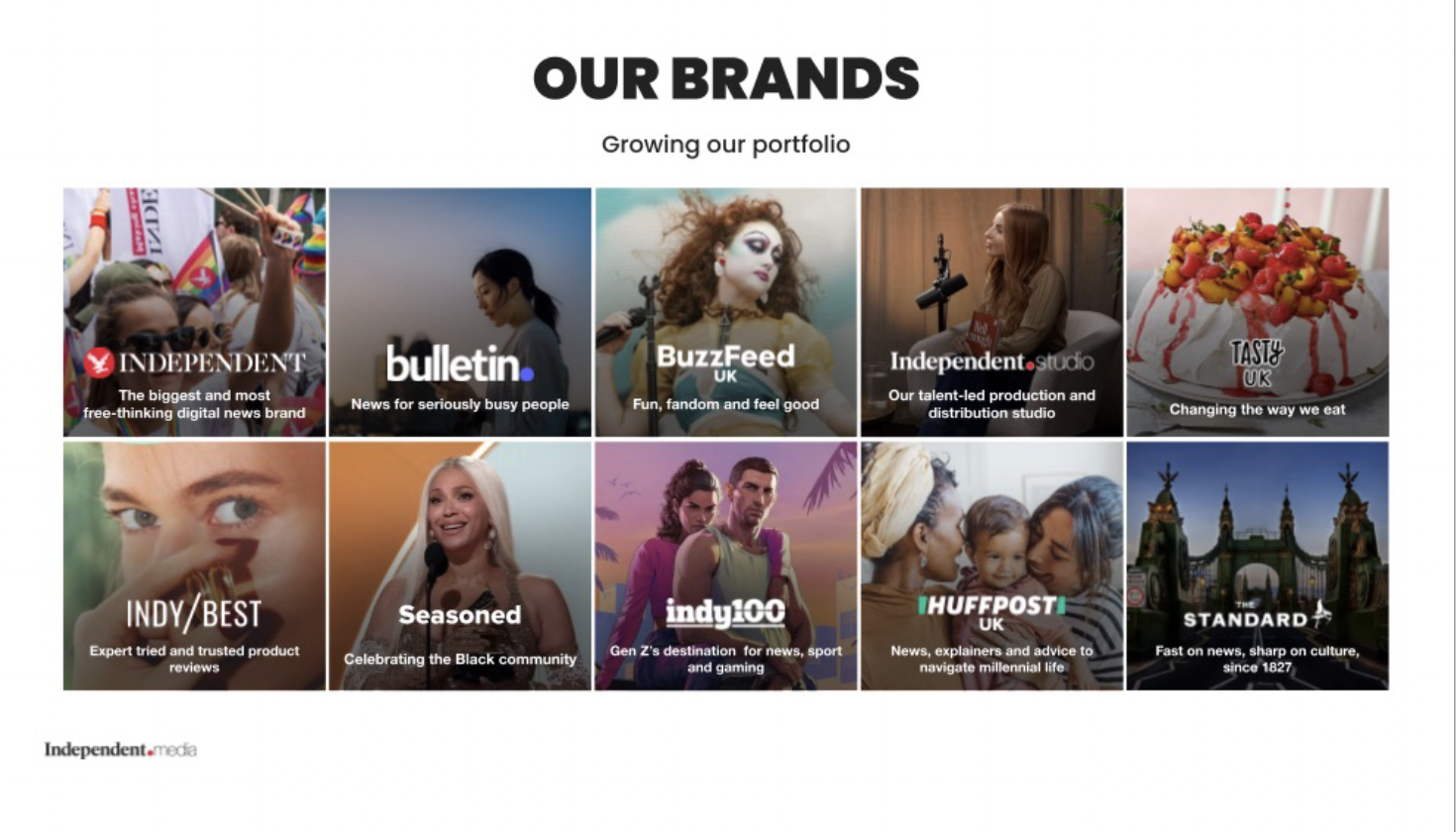
Rather than operating strictly as a single-brand publisher, The Independent has scaled its infrastructure into a broader multi-brand portfolio. This strategy offers advertisers a unified "one-stop shop" while aggregating audience reach without homogenising individual brand identities.
Key Brand Acquisitions and Partnerships
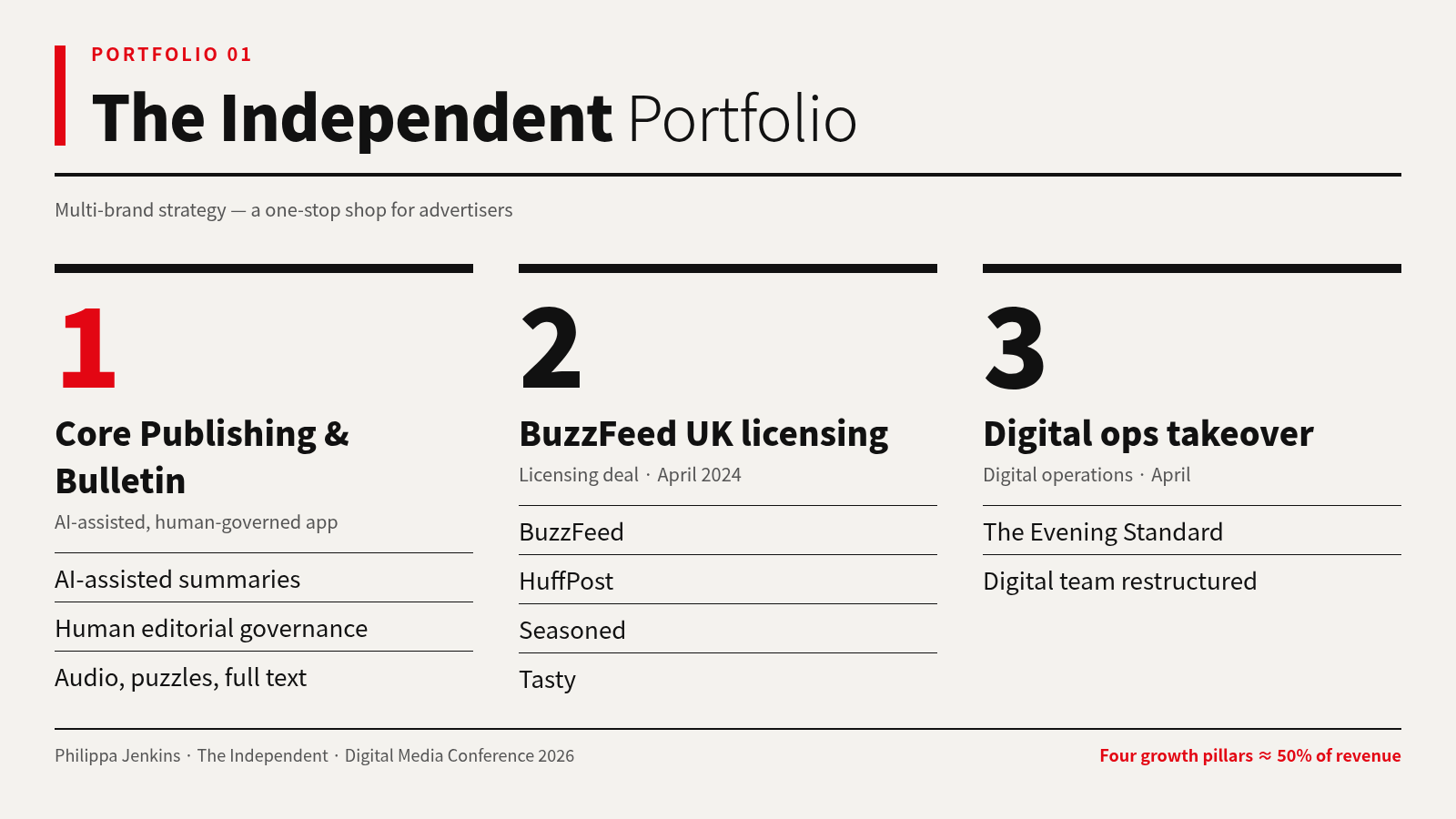
BuzzFeed Licensing Partnership (April 2024): The Independent acquired the UK brand operations for BuzzFeed, HuffPost, Seasoned, and Tasty. This integration established a combined brand strategy that allows advertisers to connect across multiple distinct audiences through a single point of entry while preserving each title's distinct operational approach.
Digital Operations of The Evening Standard (April): The organisation assumed full control of The Evening Standard’s digital presence. This required a radical restructuring of the digital team's size, shape, and operational workflow to stabilise the asset, prevent brand stagnation, and secure long-term digital sustainability.
Core Growth Drivers and Revenue Mix
According to recent WAN-IFRA World Press Trends reports, the fastest-growing revenue segment across the global publishing industry is categorised as "other"—encompassing non-traditional streams like events, syndication, and AI integrations. The Independent has structured its growth strategy around this industry-wide shift.
Breakdown of Core Revenue Pillars
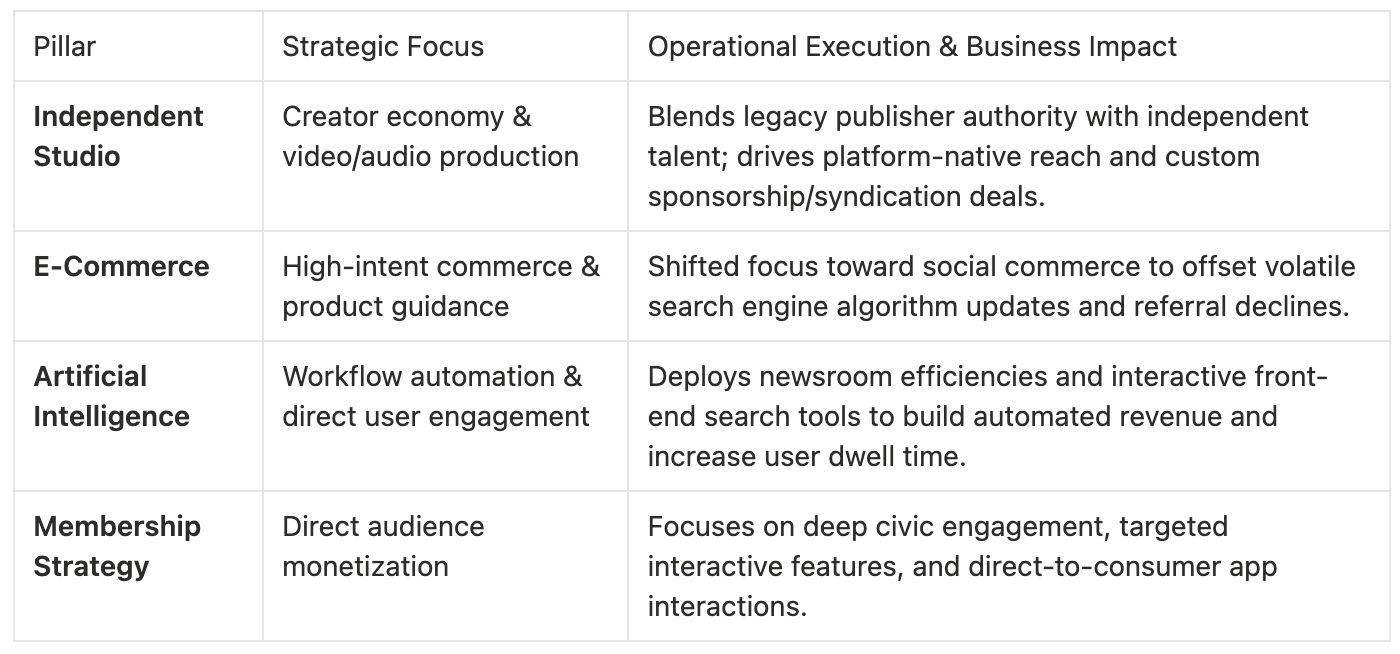
These four distinct pillars currently generate nearly 50% of the company's overall revenue.
Product Innovation: Case Study on Bulletin
To address declining search and social referral traffic, The Independent launched Bulletin, a dedicated app-based proposition designed specifically for time-poor consumers seeking rapid news consumption and trusted product recommendations.
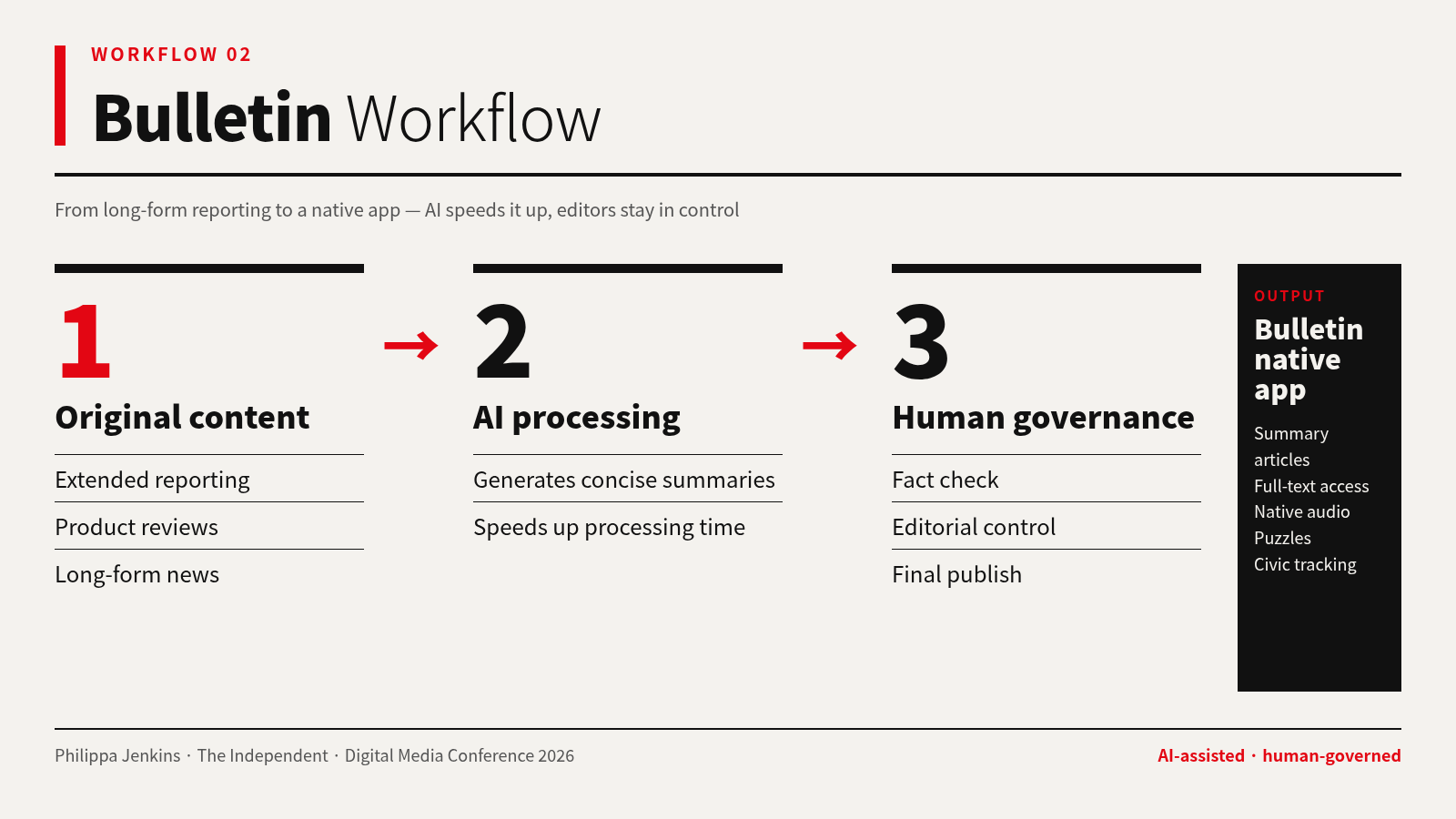
Key Operational Features of Bulletin:
AI-Assisted Processing: Uses AI tools to quickly convert long-form, authentic reporting into digestible summaries.
Strict Human Editorial Governance: Newsroom editorial teams manage and govern content processing directly to maintain brand trust and accuracy.
Multi-Format Consumption: Features text summaries, options to expand into full-form articles, integrated audio playbacks for hands-free listening, and interactive features like puzzles.
App-Centric Distribution Strategy: Bypasses web-based algorithm volatility by routing users into a controlled native app environment, evaluated primarily through civic engagement metrics.
Creator Economy Integration: Independent Studio
The Independent Studio was established to reimagine traditional media operations by combining creator-led formats with legacy publishing trust and infrastructure.
The Studio commercial & talent framework rejects a standard "one-size-fits-all" contract structure. Instead, contracts are tailored to each creator and format, covering acquisitions of existing shows or brands, co-creations, and talent-sharing models. Its distribution optimisation counters the loss of traditional web referrals by distributing content natively on third-party video and social platforms where modern audiences consume media.
Monetisation mechanisms generate revenue through custom channel sponsorships, direct ad sales, platform revenue shares, and syndication deals made possible by The Independent's brand scale.
Case Study: The Studio Partnered with creator Adam Cleary to launch ACFC, a football-focused YouTube channel. The project met its three-month growth benchmarks ahead of schedule and achieved audience engagement metrics comparable to those of top-tier YouTube creators.
E-Commerce Evolution and Social Commerce Pivot
While e-commerce has historically been a critical revenue driver for The Independent, changing search engine dynamics, specifically unanticipated referral fluctuations from Google, forced a rapid restructuring of the department's operational model. To reduce its reliance on web-search affiliate links, the publisher pivoted toward social interaction.
In September 2026, revenue generated from social commerce initiatives officially surpassed revenue derived from standard e-commerce editorial content/affiliate links.
Takeaway: Consumers still seek expert, trusted buying guidance, but require it delivered natively within social platforms via alternative formats rather than standard web-article affiliate lists.
Artificial Intelligence Implementation and Monetisation
The Independent maintains four formal AI workstreams across the organisation, prioritising measured deployment, strict human oversight, and data control. The key operational focus areas and applications that comprise their AI strategy include:
Content & Newsroom Efficiency: Deploying AI tooling to automate manual processing tasks and create summary content (such as for the Bulletin product and the Taboola Deep Dive feature). This efficiency frees up editorial teams to focus on producing original, authentic content.
Business Operations: Applying AI workflows and processes across non-editorial parts of the business to replace manual tasks and improve overall productivity.
User-Facing Interactive Features: Offering front-end AI tools to readers, such as article summaries, prompt suggestions, and free-form Q&A, which enhance page dwell time and reader engagement.
Machine Learning & Monetisation: Utilising broader machine learning (ML) models rather than just generative AI, covering areas such as contextual advertising and dynamic paywalling
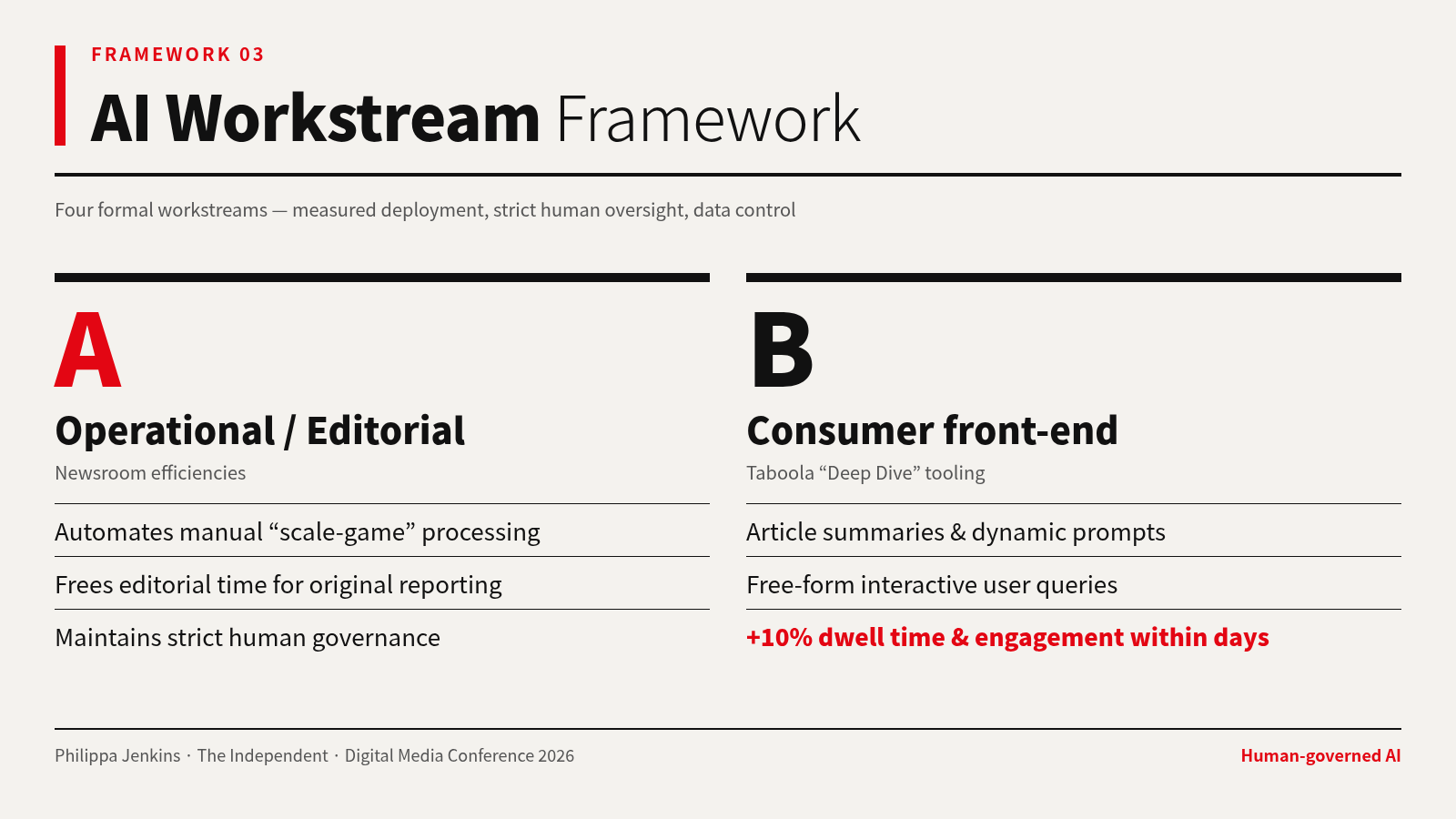
Operational Workflows vs. Newsroom Efficiencies
Automated processes handle repetitive tasks, freeing editorial teams from low-value, web-scale tactics so they can focus on original, high-value journalism and move beyond the "Scale Game", while automated content revenue speeds up internal processing, sustaining and optimising automated syndication and programmatic content revenues.
Front-End Consumer Implementation: Taboola "Deep Dive"
Deployment: Rolled out on HuffPost UK in April and on The Independent core site shortly thereafter.
Functionality: Generates automated article summaries, offers preset contextual reading prompts, and provides a free-form query box that lets users ask questions answered directly from The Independent’s content library.
Performance Metrics: Increased user dwell time and page engagement by up to 10% within the first few days of implementation.
Direct Revenue Optimisation and Prerequisites
The Hybrid Approach to Long-Term AI Revenue
To move beyond simple cost-cutting and achieve long-term revenue growth, publishers rely on a hybrid model combining Generative AI, traditional Machine Learning, and strategic reinvestment in the data infrastructure:
Front-End Interactive GenAI (Dwell Time & Engagement): Deploying reader-facing Generative AI tools—such as the Taboola Deep Dive tool for article summaries, prompt suggestions, and free-form Q&A—delivers immediate engagement lifts. Increases in page dwell time (up to 10% within days of launch) directly boost programmatic and ad revenues.
Machine Learning for Yield Optimisation: Shifting focus beyond Generative AI toward broader Machine Learning (ML) models enables publishers to drive revenue through contextual advertising and dynamic paywalling based on user behaviour.
Reinvesting Efficiencies into Original Content: By using AI to automate routine content processing, editorial and creative teams are freed to focus on high-margin, authentic original journalism and creator partnerships (such as Independent Studio and social commerce) that drive core subscriber and partner revenue
Operational Takeaways for Publisher Leadership
Embrace Active Testing: Publishers must maintain an organisational tolerance for experimentation. Metrics must determine whether a project scales or is discarded before legacy products stagnate.
Decouple Growth from Third-Party Referrals: Diversifying into native apps (Bulletin), direct creator media (Independent Studio), and native social shopfronts safeguards revenue against ongoing search engine and social platform volatility.
Structure Multi-Brand Scale Efficiently: Centralising commercial infrastructure across acquired properties (BuzzFeed UK, The Standard) lets publishers capture broader advertiser budgets while maintaining each brand's distinct operational voice.
This article summarises a presentation by Philippa Jenkins, Head of Registered Audience at The Independent (UK), delivered at WAN-IFRA’s Digital Media Conference in London on October 23, 2026, and was produced with Gemini's assistance. A Syndeai editor reviewed and edited it.