
Credit: priscilla du preez - unsplash
The French Jean-Jaurès Foundation has released the third wave of its news fatigue observatory. Four years of longitudinal research across four European news markets (France, Germany, Italy, and the United Kingdom) show a significant shift in how citizens consume, process, and respond to news information.
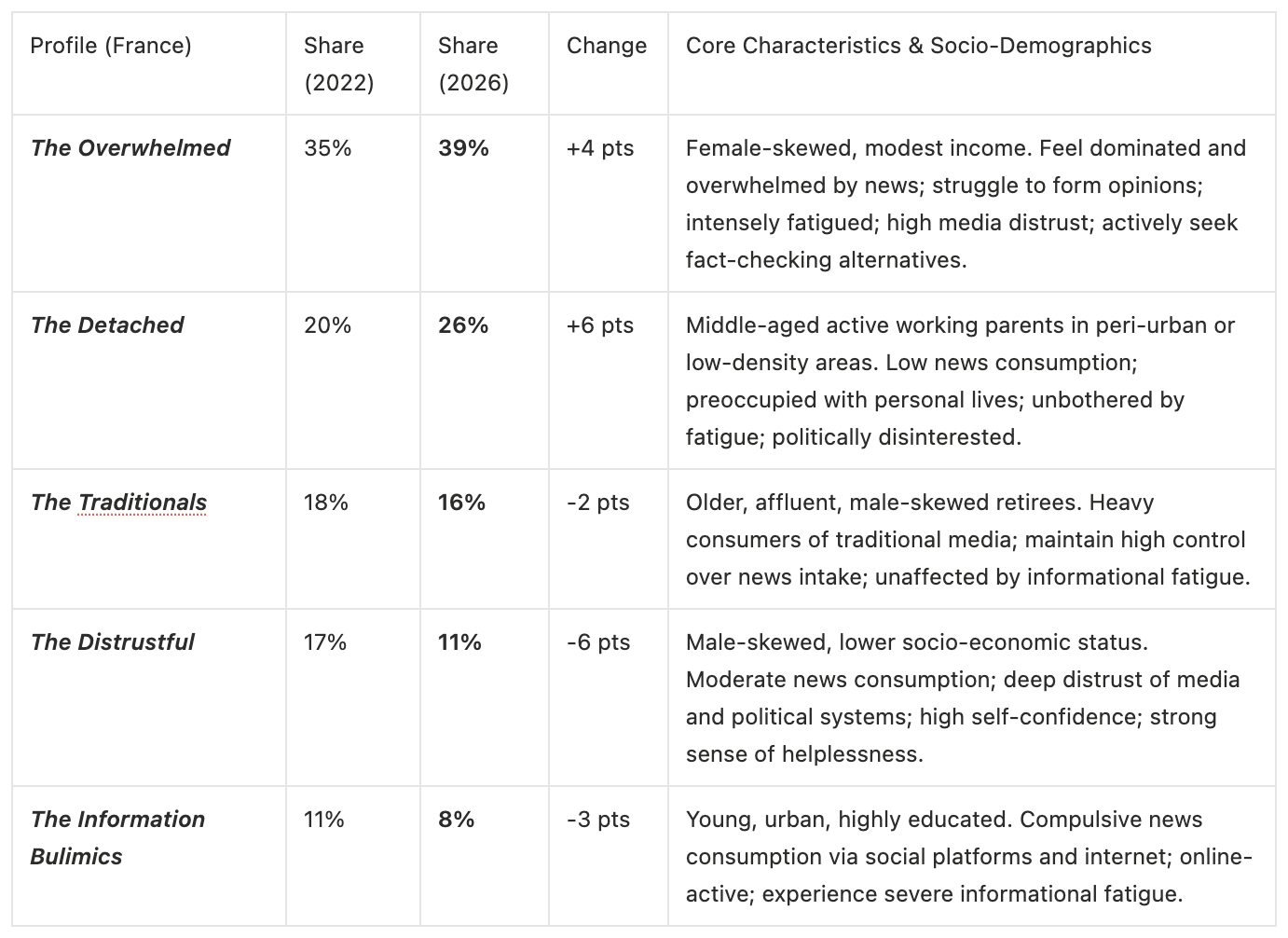
The big picture: Audiences are not just tired of the news; they are limiting exposure to protect their attention and emotional well-being. In France, news fatigue stands at 55%; 74% restrict or pause their news consumption. Despite apparent stability compared with the 2022 data, “The Detached” have grown to 26% and “The Overwhelmed” to 39%
Across Europe: France retreats, Italy “cross-checks”, the UK relies on personal judgment, and Germany leans on trusted media institutions. Each approach carries vulnerabilities.
Why it matters: Individual relief can come at a collective cost: fewer shared facts and reference points for democratic debate.
For publishers: Clear summaries, transparent sourcing, segmented audience-specific formats, and constructive reporting reduce the burden of staying informed, offering understanding rather than more updates.
What began as widespread informational fatigue (53% in 2022) turned into an informational exodus in 2024 and has now crystallised into informational self-protection in 2026. Today, 74% of respondents actively limit or interrupt their current-events tracking to protect their attention and mental balance.
Overall fatigue levels seem stable at first glance (from 53% in 2022 to 55% in 2026). However, a significant underlying change in the population has taken place:
Active engagement profiles, such as The Information Bulimics (8%) and The Distrustful (11%), have declined.
The Detached, citizens who disengage from news entirely, have grown significantly (+6 percentage points to reach 26%).
The Overwhelmed, those who feel dominated and exhausted by news, now form the largest segment at 39% (+4 percentage points).
Information has shifted from a useful resource to a source of overwhelm. Many citizens report feeling powerless due to the abundance of information, with 81% expressing a sense of despair about humanity when watching the news and 54% feeling so overwhelmed that they struggle to gain perspective. While this trend may offer individual mental health benefits through self-preservation, it poses a significant collective challenge to democracy by undermining shared facts and public debate.
Four-Year Trajectory: 2022 to 2026
Over the past four years, the research highlights a distinct progression in public attitudes toward media and news consumption over four years:
2022 ⸰ Informational Fatigue: Information began to exhaust citizens and failed to aid understanding. 53% reported feeling fatigued by the news environment.
2024 ⸰ Informational Exodus: Public distancing translated into behaviour. The average number of news channels regularly consulted dropped from 8.3 (2022) to 7.4 (2024).
2026 ⸰ Informational Self-Protection: Exposure becomes deliberate and defensive. 74% of individuals restrict or halt their news consumption to shield their cognitive bandwidth and emotional well-being.
The Recomposition of News Fatigue
News consumption falls into five distinct profiles, based on levels of information fatigue and engagement:
Feeling powerless in the face of the news
Being informed does not necessarily make people feel more empowered or more at ease. Many end up feeling overwhelmed and distressed. Too much information can leave people feeling overloaded, unable to retain anything useful, and as though they are enduring the news without being able to act.
Information overload: 54% of respondents say there is so much information that they can no longer take a step back. 18% feel this often, and 36% sometimes.
Mental fatigue: By the end of the day, 69% feel they have read or heard nothing useful or interesting. It is like eating a lot without really being hungry: you feel full, but not nourished.
Powerlessness in the face of the news: The more people follow current events, the less capable they feel of acting. 81% feel powerless in the face of what is happening in the world, and an equal proportion feel despair when watching the news. Most feel they endure the news rather than choose to follow it.
Public perception of media roles: both useful and harmful
Citizens hold deeply contradictory views regarding the function of modern media. People see the media as both useful and harmful. They value it for timely updates, crisis coverage, and different viewpoints, while also feeling that it can heighten conflict and favour emotion over analysis. These views can coexist: the media may help people stay informed while also making the news feel overwhelming or less trustworthy.
They hold mixed views about the role of modern media. Many appreciate its ability to provide real-time updates and help people follow major events: 59% value its continuous coverage, and 58% consider it indispensable during crises. Nearly half (47%) also see value in the range of viewpoints and analysis it can offer.
At the same time, many respondents criticise how news is presented. Seventy-two per cent believe the media amplifies controversy and social tensions, while 71% feel it prioritises spectacle and emotion over analysis. Together, these findings suggest that people rely on media for information but worry its coverage can intensify conflict rather than help them understand events.
Barriers to Comprehension and Opinion Formation
Many people find it difficult to follow long-term event storylines and establish clear personal opinions amidst competing media offerings. Fifty-nine per cent struggle to identify what is truly important, while 58% have difficulty distinguishing reliable information from fake news. These challenges can make it harder to follow events over time and form a clear opinion amid competing accounts.
Four Countries, Four Configurations
The international benchmark conducted alongside the 2026 research expanded the French survey (4,000 respondents) to include three additional European countries with 1,000 respondents each: Germany, Italy, and the United Kingdom. The benchmark demonstrates that while informational fatigue is a shared European challenge, each nation exhibits a distinct strategy and set of vulnerabilities in coping with news overload.
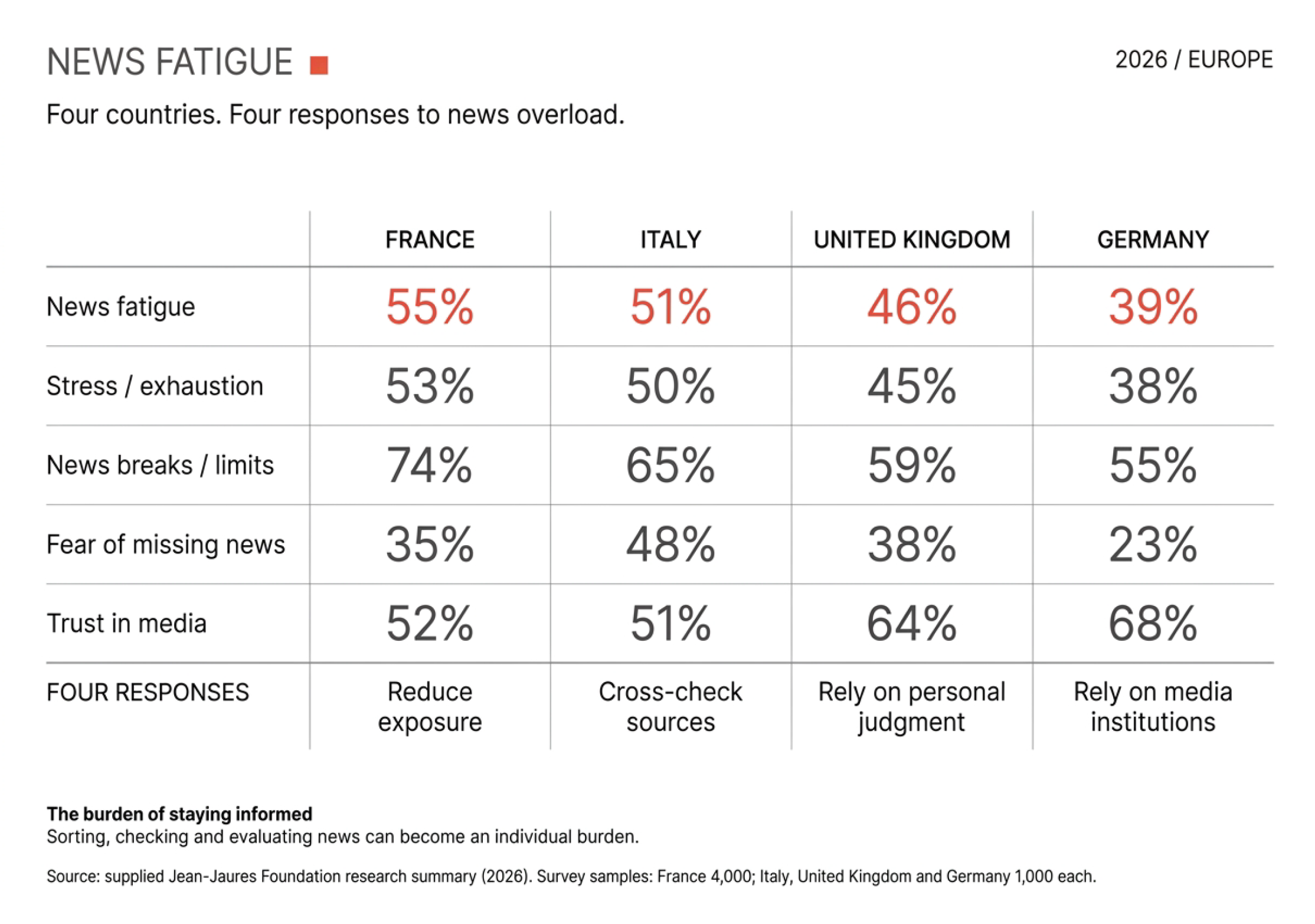
The true cost of news fatigue stems less from the raw volume of content than from the burden on individuals of sorting, verifying, and evaluating news when delegation to mediating institutions breaks down.
The "cost" of information fatigue does not stem from the sheer volume of information. Rather, it arises from the labour each individual must undertake, alone, to sort, verify, and evaluate that information, at a time when the institutions that once did this for us no longer seem to be fulfilling their role.
The problem is not merely "too much information," but also "too much work to do on one’s own." In the past, we could rely on intermediaries (media outlets, journalists, and institutions) to filter information, fact-check, and explain what mattered. Today, that trust is fracturing, leaving individuals to handle everything themselves: deciding what to believe, cross-referencing sources, and determining what is significant.
In Germany, where trust in the media is highest (68%), information fatigue is at its lowest (39%). In Italy, where trust is fragile (51%), people are constantly verifying their sources—a process that creates an exhausting cycle.
France - Reduction and Retreat
France records the highest rate of informational fatigue at 55%, with a similar share of respondents feeling exhausted or stressed by news overload. 74% of French respondents actively limit or pause their news consumption to cope.
While cutting back offers personal self-protection, it leads to rarer discussions around news (sharing dropped from 40% to 27% over four years), risking a silent democratic detachment. Trust in the media stands at 52%.
Italy - Endless Cross-Checking
51% report news fatigue and 50% feel stressed/exhausted by information. Italian respondents display the highest engagement, consulting an average of 9 channels and actively cross-checking sources (74%).
Against a backdrop of fragile media trust (51%), intense verification creates an exhausting, endless loop of research that fails to eliminate uncertainty. Italy shows the highest fear of missing out on information (48%), and 65% report browsing longer than intended.
United Kingdom - Attention Overflow
46% experience news fatigue and 45% report stress/exhaustion. British respondents express strong cognitive self-reliance, with 93% feeling confident in their ability to inform themselves online. Media trust is relatively high at 64%.
High confidence in critical judgment is undermined by a struggle for attentional control: 58% scroll videos longer than planned and 52% struggle to resist trivial headlines.
Germany - Institutional Delegation
Germany shows the lowest levels of news fatigue (39%) and exhaustion (38%) among the four nations.
A majority relies on traditional media delegation, backed by the highest trust in media (68%).
Although the national average appears the calmest, it conceals deeply fragmented trust across different public segments.
Collective Implications for Democratic Life
The effects extend beyond the individual. The growth of “The Detached” (+6 percentage points) and “The Overwhelmed” (+4 points) means fewer shared reference points for public discussion, making it harder to build common understanding and sustain democratic debate
The shift toward individual self-protection creates a paradox.
Reducing news intake effectively shields individuals from emotional exhaustion, cognitive overload, and anxiety. But with fewer opportunities to build a shared factual understanding, the democratic capacity for collective deliberation is increasingly strained.
How News Media Respond
To re-establish civic relevance, address the 74% active self-protection rate, and regain commercial sustainability, news organisations must abandon attention-capturing tactics. Media executives must transition toward attention-respecting architectures centred on "critical delegation", a model in which audiences confidently delegate the cognitive burden of exhaustive global monitoring to trusted editorial gatekeepers who curate, synthesise, and contextualise reality.
By embracing critical delegation, tailored segment product design, and constructive framing, publishers can restore the democratic utility of journalism and forge sustainable, trust-based relationships with modern audiences.
Establishing "Critical Delegation"
News organisations repositioning their core value proposition from delivering real-time volume to providing curated intellectual clarity relieve the public from constant monitoring anxiety.
The priority is understanding rather than speed or volume. This translates to giving stories a clear hierarchy, providing context, and offering analysis rather than rushing to publish more updates. Those editorial choices make clear why a development deserves attention and help readers distinguish lasting changes from passing controversies and digital noise.
As many new formats in France and internationally already demonstrate (Brief.me, Le Monde’s La Matinale, The New York Times’ The Morning and The Daily, FT Edit, The Economist’s Espresso, Semafor’s daily flagship newsletter, Axios’ Smart Brevity format,…), newsrooms are shifting from a constant stream of breaking news to regular, contextualised briefings that bring together the most important developments. These briefings help readers understand what has changed, why it matters, and how it fits into the bigger picture, without requiring them to follow the news all day.
Audience-Centric Tailored Editorial Strategies
Different audiences have different relationships with the news, so a single editorial approach is unlikely to meet every need. Publishers adapting their formats and services to the five audience profiles can help each group stay informed in ways that feel useful, manageable, and trustworthy.
For the Overwhelmed, clear structure and simplicity are especially valuable. Concise daily digests, accessible fact-checking, and explanatory journalism make complex stories easier to understand, while uncluttered layouts reduce the effort required to navigate them. For the Detached, practical and local reporting offers a more accessible route back to the news, particularly when it fits naturally into daily routines and demonstrates relevance to everyday concerns.
For the Compulsive Consumers, publishers can support healthier habits through fewer, more selective notifications, curated morning and evening briefings, and clear signals that readers have caught up on the day’s essential news. These features help engaged audiences remain informed without encouraging constant checking.
For the Distrustful, greater transparency provides a starting point for rebuilding confidence. Explaining how stories are reported, linking directly to primary sources, and making verification methods visible allow readers to assess the evidence for themselves. A fair presentation of competing perspectives also supports trust while respecting readers’ independence of judgment.
For the Traditionalists, continuity matters more than reinvention. Carefully curated print editions and in-depth digital coverage preserve the clear editorial hierarchy and depth these readers value, while maintaining a dependable experience across formats.
Constructive Journalism to Counteract News Anxiety
To directly counter the 81% powerlessness metric and rebuild audience engagement efficacy, newsrooms increasingly reframe their stories, drawing on constructive editorial practices and de-escalating conflict frameworks.
Constructive journalism models systematically pair problem identification with historical background, systemic context, and potential solution frameworks or community responses. The de-escalation of conflict emphasises multi-perspective, balanced analytical reporting that lowers emotional friction. It actively reduces reliance on artificially amplified controversy and sensationalised outrage.