
Image Credit: Camilla Bundgaard - Unsplash
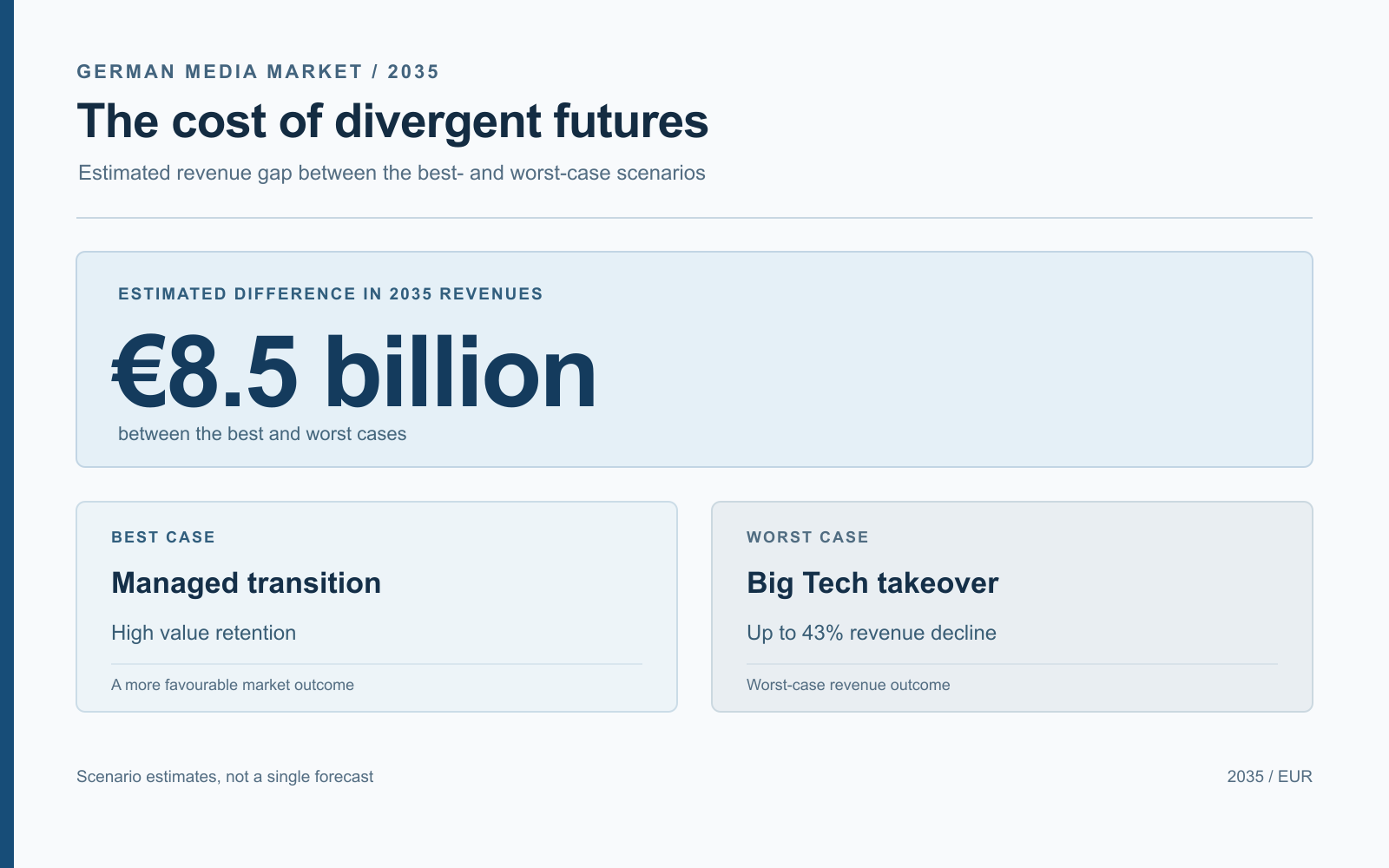
Once considered among the most prosperous, stable and diversified markets in Europe, Germany’s news media face sharply different futures by 2035, depending on regulation, AI development and industry cooperation. In “Der deutsche Medienmarkt 2035”, a report commissioned by ARD, ZDF and Deutschlandradio, Prof. Dr Christian Zabel (TH Köln) & Prof. Dr Ulrike Rohn (University of Tallinn) estimate an €8.5 billion revenue gap between its best and worst scenarios.
The report concludes that news media in Germany face revenue losses of up to 43 per cent by 2035.
For the report, the authors condensed 281 forecasts from 57 studies into 51 trends. 34 experts assessed these, resulting in four scenarios. Platforms and AI providers dominate in all four scenarios. Use of domestic media could fall by 18 to 47 per cent by 2035, and the number of journalists by 12 to 50 per cent. The revenue gap between the best and worst case is around €8.5 billion.
How sharply revenues fall depends, among other things, on regulation, the pace of AI development and market cooperation. Without countermeasures, the outlook is either "Steady Erosion" or "Dominance of the Tech Giants". The authors therefore call for stricter platform regulation, easier cooperation between players, and stronger support for public-value content.
Executive Summary
The report assesses structural shifts across the German news media sector over the next decade, evaluating how artificial intelligence, platform power, and changing user behaviours affect media economics, and identifying options to safeguard public-value journalism.

Key Takeaways
High Economic and Social Stakes: Standard commercial publishing models face severe erosion across all potential futures. Depending on regulatory choices, AI adoption speeds, and industry collaboration, domestic publishers face potential advertising and distribution revenue declines of up to 43%, representing an €8.5 billion revenue gap between the best-case and worst-case scenarios by 2035.
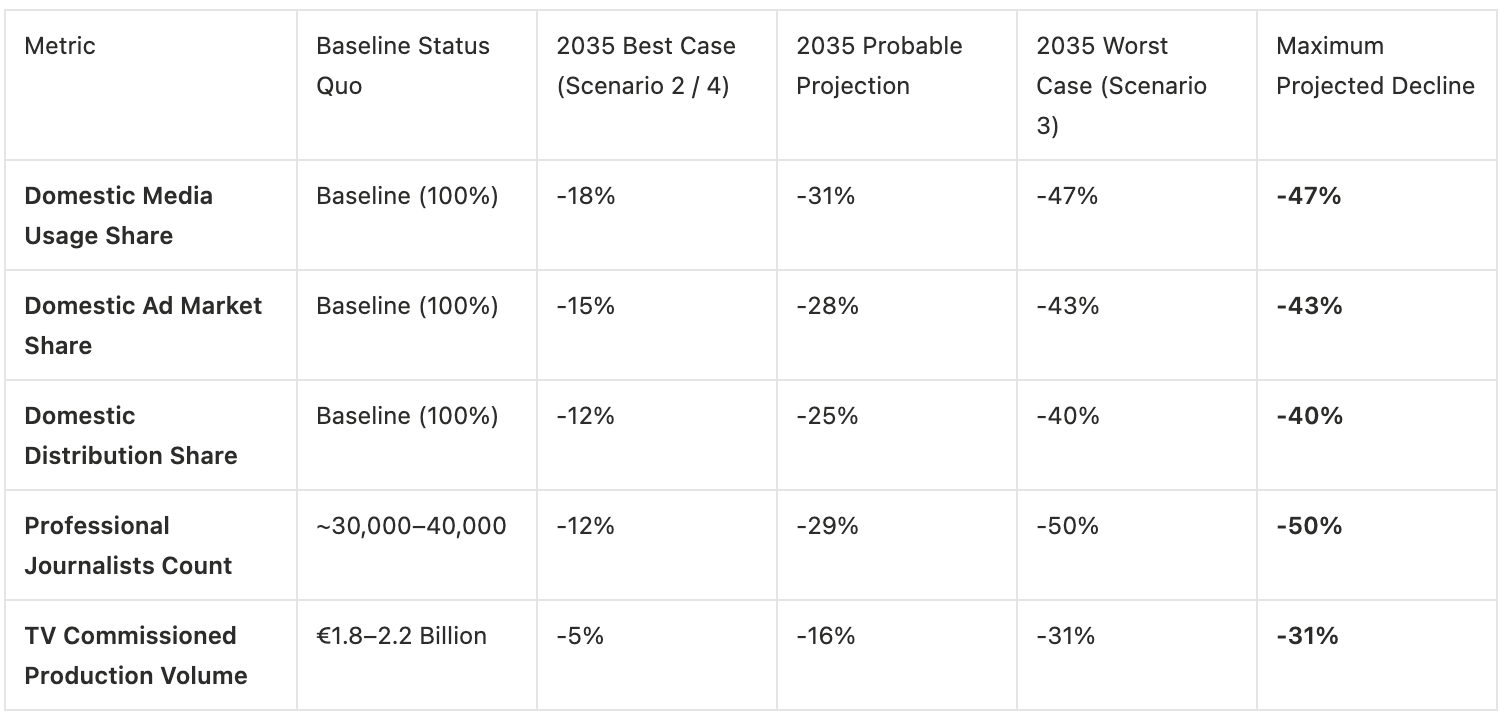
Severe Operational Contraction: Projections indicate domestic news media usage could drop between 18% and 47%. The professional journalistic workforce could shrink by 12% to 50%, while the volume of commissioned TV productions risks falling by 5% to 31%.
Inability to Self-Correct: The domestic media industry cannot reach favorable outcomes through individual market actions alone. Without regulatory interventions targeting international AI and platform gatekeepers, the industry defaults toward adverse baseline scenarios.
Public Service Broadcasting as Critical Infrastructure: Public service broadcasting serves as an economic stabilizer and market shaper. In extreme downturns, maintaining constant program and staffing budgets could account for up to 40% of all professional journalists and 75% of commissioned TV production volume in Germany.
Imperative for Active Intervention: Scenarios driven by platform dominance occur automatically if no policy changes are made. Reaching sustainable futures requires functional regulation, shared digital infrastructures, tax and investment incentives for public-value content, and modernised competition frameworks enabling cross-publisher cooperation.
Trend Analysis & Core Structural Drivers
Baseline Certainties
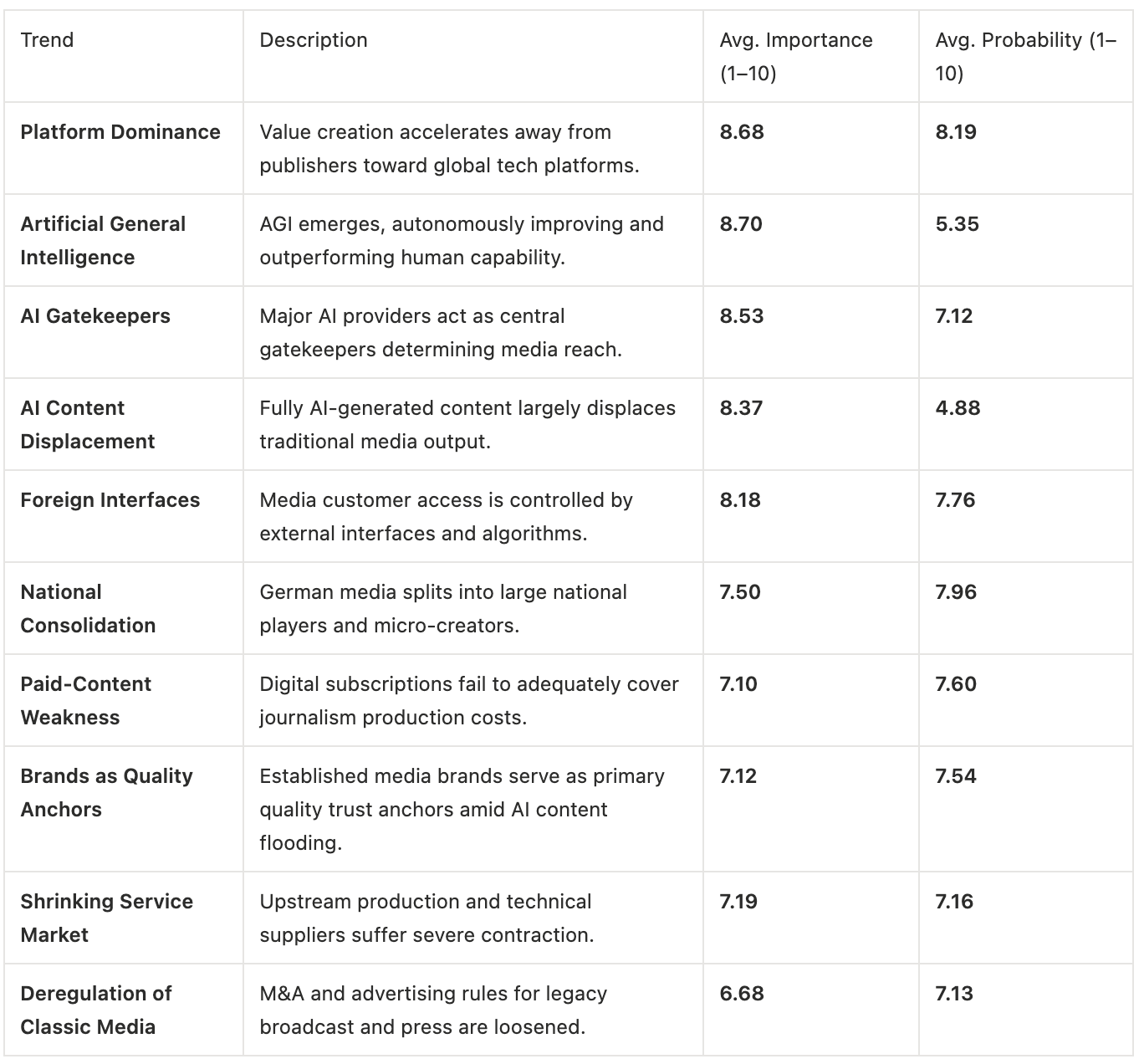
Across all evaluated scenarios, experts reached high consensus on several structural realities for 2035:
Platform & AI Dominance: Global tech platforms and AI gatekeepers control the primary points of user discovery and interface layers.
Hyper-Individualized Consumption: Content consumption moves away from traditional mass editorial bundles to algorithmically personalised feeds and on-demand pull formats.
Structural Industry Consolidation: Mid-sized media enterprises face elimination, leaving a market split between a few large national organisations and small niche creators.
Shrinking Service Sector: The market for upstream suppliers, independent journalism bureaus, and technical media service providers shrinks significantly.
Persistent Low Willingness to Pay: Consumer willingness to pay for digital news remains insufficient to independently fund full-scale journalism.
Detailed Scenario Profiles
Scenario 1: Shifting Sands
Market Dynamics: Platform dependence deepens steadily as global intermediaries control user access points. Domestic publishers suffer ongoing subscription and ad revenue losses.
Production & Tech: AI is adopted primarily for cost-cutting within legacy workflows. Independent creators grow in volume but struggle to build financially viable businesses.
Industry Structure: High market concentration among production houses and publishers. Sector-wide technology investments remain fragmented and underfunded. Default baseline scenario if no systemic policy actions are taken.
Scenario 2: Level Playing Field
Market Dynamics: Effective platform regulation limits algorithmic self-preferencing and secures visibility for public-value journalism. Market contraction occurs in an orderly, manageable fashion.
Production & Tech: Human newsrooms remain central, using AI to automate routine reporting and enhance investigative workflows. Creators complement traditional publishers rather than replacing them.
Industry Structure: Broad sector cooperation along the value chain, including shared ad sales operations, common distribution networks, and collaborative technological standards.
Scenario 3: Big Tech Takeover
Market Dynamics: International AI providers and platform conglomerates control access, interface layers, and monetisation algorithms. Generative content floods distribution channels.
Production & Tech: Fully synthetic, highly personalised media streams become the default. Media houses lose direct customer relationships and become low-margin content suppliers to technology platforms.
Industry Structure: Domestic publishing revenue collapses. The supplier market (independent producers, regional agencies) experiences widespread closures. Default baseline scenario under rapid AI adoption without regulatory safeguards.
Scenario 4: Into the Open
Market Dynamics: The industry undertakes a deep structural transition toward decentralised distribution, open protocols, and community-driven monetisation models.
Production & Tech: Widespread adoption of post-editorial, AI-driven tools, balanced by strong data sovereignty, verifiable content authentication, and fair compensation frameworks for training data.
Industry Structure: Revenue streams diversify into intellectual property licensing, pay-to-crawl access structures, brand extension services, and direct community engagement.
Quantitative Estimates & Systemic Action Plan
Market Projections to 2035
The panel of 13 independent industry experts quantified five key metrics for the German media market in 2035 across Best Case, Probable, and Worst Case scenarios:
€8.5 billion is the stark revenue divide between the best-case and worst-case future scenarios, and the economic room for manoeuvre for the German publishing and broadcast media sector by 2035.
The Two Divergent Futures
The study’s Best Case can be reached through active platform regulation (such as fair remuneration, anti-discrimination rules, and data portability), industry-wide technological partnerships, and a proactive public service broadcasting role, enabling the domestic media sector to manage an orderly transformation. Overall sector revenues decline by only 10% relative to the 2024 baseline.
In the Worst Case,** Global tech platforms capture interfaces, AI models, and monetisation mechanisms, reducing traditional publishers and broadcasters to dependent suppliers. Domestic media revenues collapse by 43% relative to the 2024 baseline.
The €8.5 billion delta between the two cases is the difference between retaining economic viability in an equitable ecosystem and sliding into an unmitigated structural contraction.
Breakdown of the €8.5 Billion Gap
Measured against today's total domestic advertising and circulation baseline of €26.5 billion (2024), the divide is driven by two main revenue streams:
Advertising Market (~€5.0 billion delta): In Level Playing Field, domestic publishers retain roughly 39% of the net ad market (a modest decline from 45% in 2024), whereas under Big Tech Takeover, their share plunges to 21%.
Distribution and Circulation Market (~€3.6 billion delta): In the best case, publishers maintain a 66% market share (compared to 71% in 2024), but that falls to 50% under the worst case as third-party platform bundling and customer diversion take over.
When factoring in projected broader media market growth, this divergence expands to €10.9 billion.
The Structural Stakes Behind the Numbers
This financial divergence translates directly into the survival of core journalistic resources:
News Media Workforce: The number of professional journalists could contract by 12% in the best case (down to ~35,000) versus a 50% collapse down to 20,000 in the worst case (from 40,000 in 2023).
Production Volume: Independent commissioned television/video production volumes face a nominal decline between 5% and 31% (a gap of approximately €800 million).
Public Discourse: In the downside scenarios, this financial drain leads to local news deserts, severe audience polarisation, and a vulnerability to synthetic/unauthenticated information.
Policy and Industry Recommendations
To prevent default outcomes (Scenarios 1 and 3) and move toward sustainable futures (Scenarios 2 and 4), the report outlines four required interventions:
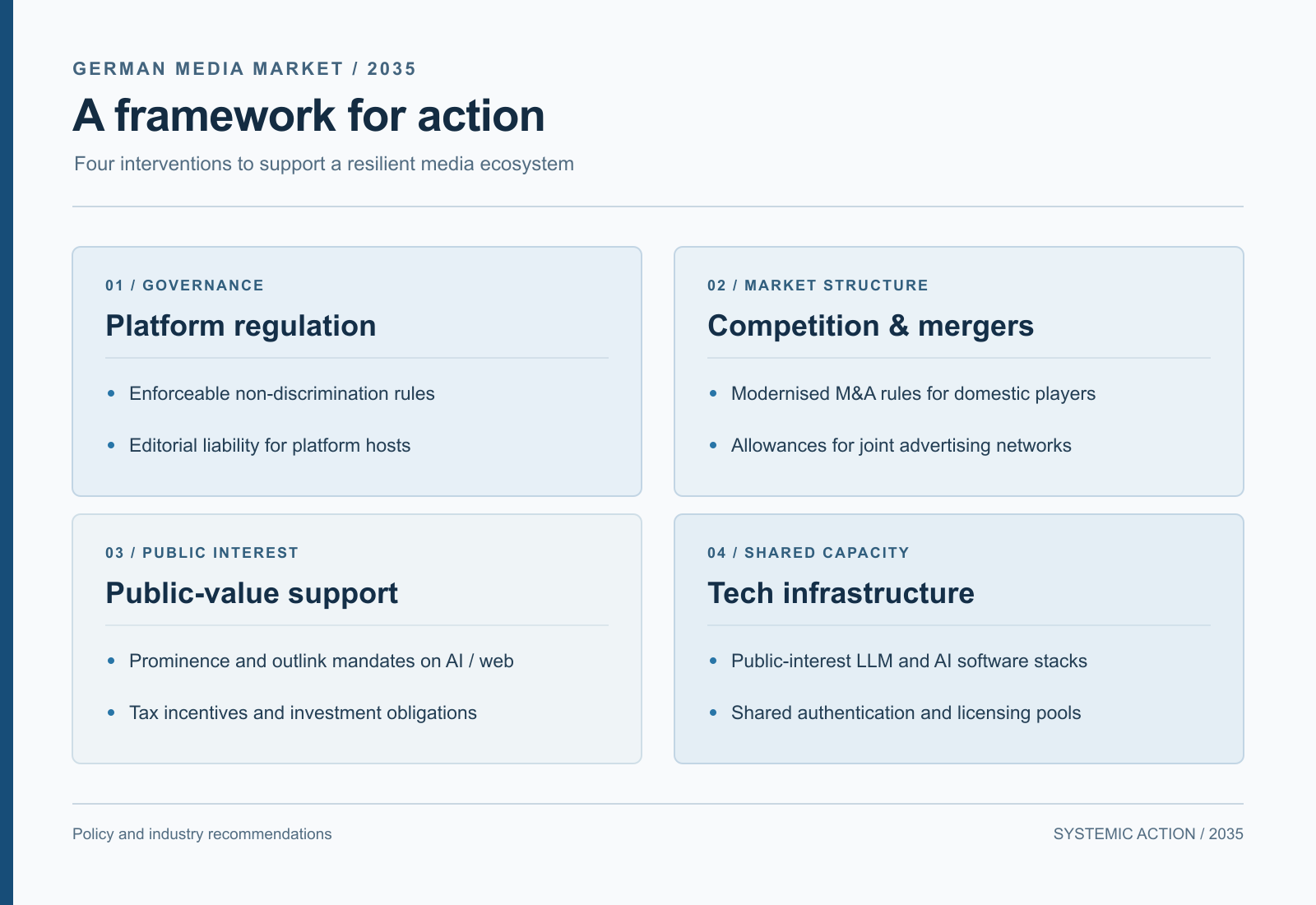
Strict Platform & AI Regulation:
Extend editorial liability and reporting obligations to major tech platforms.
Enforce non-discrimination mandates and mandatory outlinks to original sources within AI-generated search summaries.
Secure data sovereignty enabling users to port their profile and interaction data across platforms.
Modernized Competition Frameworks:
Adjust merger control laws (Fusionskontrolle) to allow domestic publishers to consolidate non-editorial business operations.
Authorize joint advertising sales platforms and co-developed technological infrastructure without antitrust penalties.
Targeted Public-Value Funding Mechanics:
Establish legal prominence rules ensuring journalistic content remains discoverable on automated interfaces and conversational AI agents.
Introduce investment obligations (Investitionsverpflichtungen) and tax incentives for tech platforms to fund original local reporting.
Direct financial support toward independent non-profit newsrooms and regional investigative networks.
Industry-Wide Technological Innovation:
Shift AI implementation from basic operational cost reduction to novel format creation and personalised public-service products.
Develop shared domestic media technology stacks (Media-Tech Stacks), including open licensing hubs for AI training data and unified subscription infrastructure.
Strategic Dual Role of Public Service Broadcasting: Market Shaper vs. Market Stabiliser
The study highlights that Public Service Broadcasting provides structural resilience for the broader German media ecosystem:
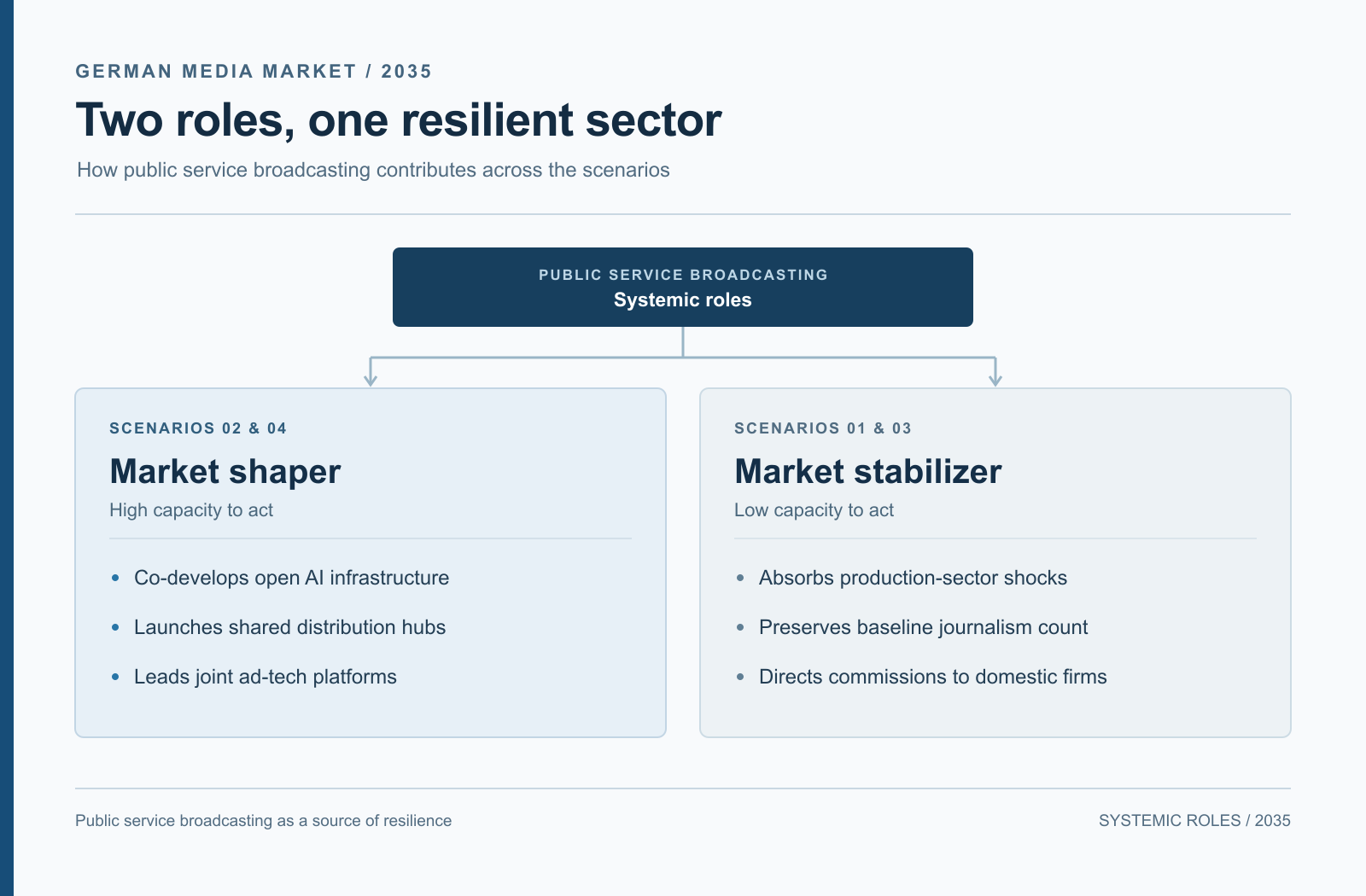
Quantified Impact on Sector Stability
Under ceteris paribus conditions (assuming steady real-term funding for Public Service Broadcasting while the commercial market contracts), public broadcasting's relative contribution to the national media ecosystem grows significantly:
In the 2035 worst case, public service broadcasting could account for up to 40% of professional journalists in Germany and 75% of domestic commissioned TV production volume, assuming steady real-term public funding.
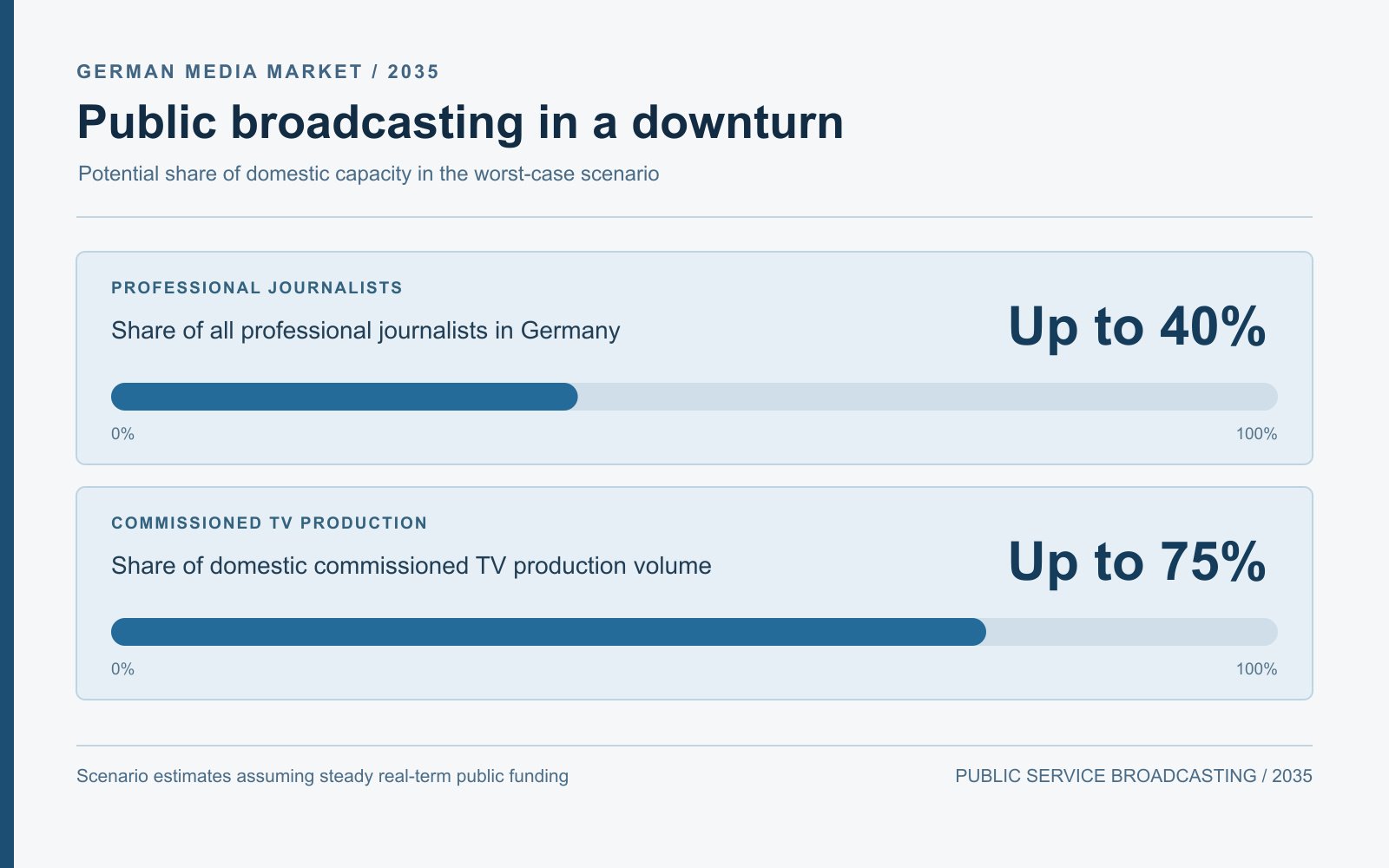
In Scenario 3 (Big Tech Takeover), PBS newsrooms would employ up to 40% of all professional journalists in Germany. In severe downturns, PBS production budgets would account for up to 75% of total commissioned TV production volume, serving as a financial anchor for regional creative clusters.
Key Contributions Across Functional Areas
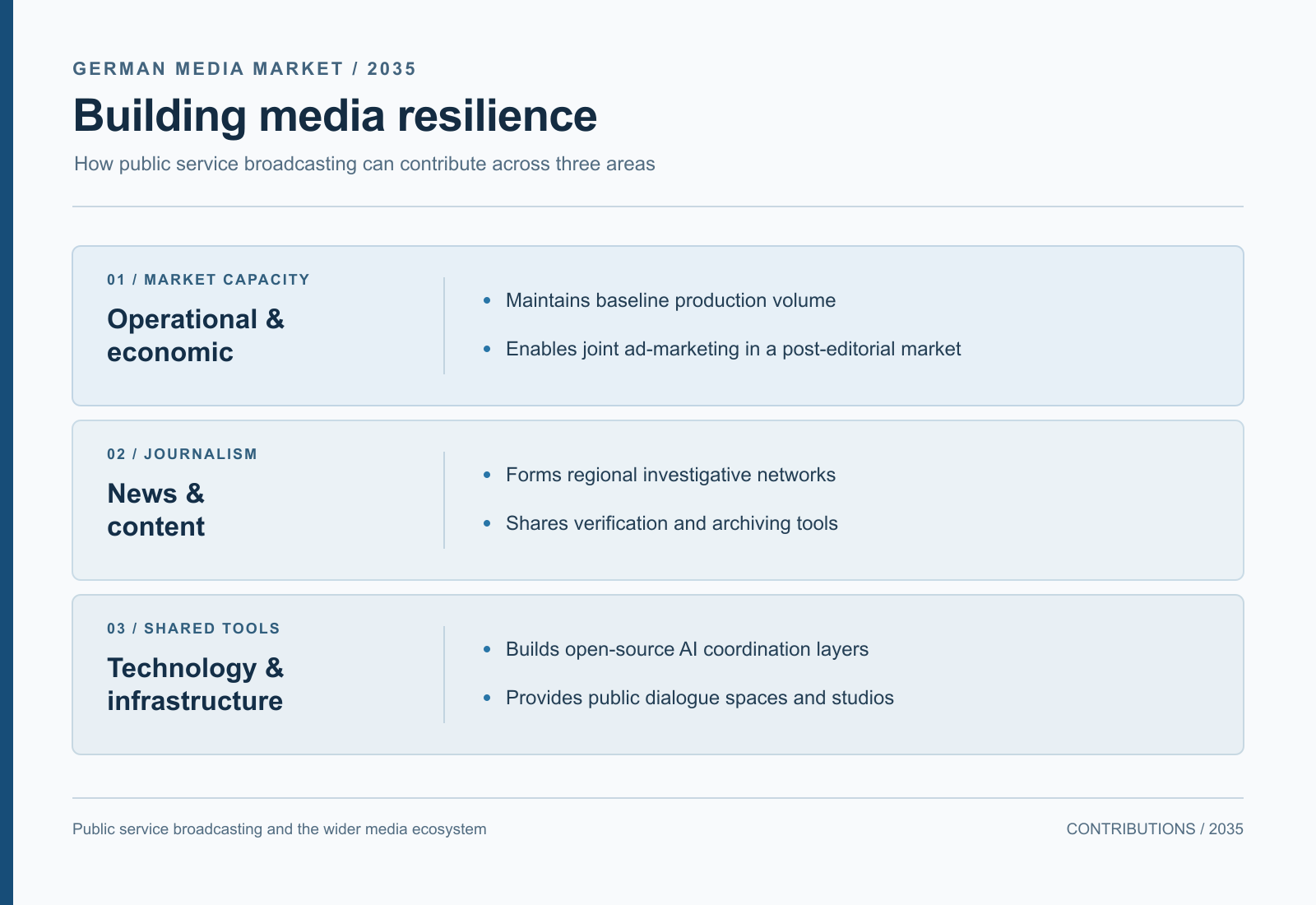
Market & Operational Contributions:
Sustains investment in independent, regional film and TV production companies.
Explores joint ad-marketing infrastructure with private publishers to maintain domestic advertising reach against global platforms.
Journalistic & Content Contributions:
Establishes collaborative regional reporting networks with local newsrooms.
Provides shared content verification, fact-checking infrastructure, and deep-fake detection tools to independent publishers.
Transfers technology capabilities to smaller newsrooms to foster next-generation public-interest formats.
Technological & Infrastructural Contributions:
Develops open-source public AI architectures, shared publishing APIs, and standardised authentication protocols.
Converts physical regional facilities into open innovation hubs, recording studios, and public dialogue spaces.
This article summarises “Der deutsche Medienmarkt 2035”, a report authored by Prof. Dr Christian Zabel (TH Köln) & Prof. Dr Ulrike Rohn (University of Tallinn), commissioned by ARD, ZDF, and Deutschlandradio (October 2026). https://medienmaerkte2035.de/. Artificial intelligence (Gemini Notebook, Sonnet 5.5) helped draft the text and create the visual elements. The content was subsequently reviewed and edited.