Small Rooms, Big Intelligence: How Polaris Media Vest is Winning the AI Arms Race

Marit Kalgraf, CEO, Polaris Media Vest, and Kaja Distad, AI & Innovation Driver, Polaris Media, at WAN-IFRA’s Paris AI Forum, 16 Sept 2026.
Polaris Vest’s tiny newsrooms are currently out-innovating global giants. By refusing to succumb to the "wait-and-see" trap, Polaris Media's regional branch has transformed from a collection of small-town outlets into an agile pioneer in AI implementation.
In Southwest Norway, the geography itself is a hurdle. Running 10 small local newspapers across this region means navigating a maze of fjords, where travel times stretch to five or six hours by car and ferry. In these isolated pockets, newsroom teams are skeletal. The largest paper employs just nine editorial staff, including the editor. No development desk, no "innovation lab," and no budget for a fleet of software engineers.
Why Waiting is the Greatest Danger
For the leadership at Polaris Media Vest, the greatest threat wasn't technical failure; it was losing agency. They recognised that if local newsrooms waited for the industry to "standardise" AI, larger players would dictate the terms, leaving small outlets with tools that didn't fit their hyper-local needs.
The catalyst for this proactive stance was a moment of rejection. While still under previous ownership, the team asked their "big brother" regional paper, Bergen Tidende, to share a Slackbot that tracked restaurant inspections. The answer was a firm "no." This rejection became Polaris's primary motivation to build its own tools. The subsequent corporate shift from Schibsted to Polaris Media proved the structural enabler: unlike the locked-down environments of larger conglomerates, Polaris offered "open configuration" and accessible settings that let newsrooms experiment freely.
Leadership framed this adoption as an "employer responsibility," viewing the upskilling of journalists as a fundamental duty of care. Instead of restrictive bans, they implemented safety guardrails that encouraged transparent experimentation.
Democratising the “Superpower”: Training Everyone, Not Just Techies
Polaris rejected the "two-tier" workforce model. They didn't want a handful of "super-users" while the rest of the staff felt obsolete. Instead, they committed to bringing every journalist along, regardless of their technical starting point.
The training program was meticulously designed in three phases:
CMS and Storytelling: Mastering basic AI integration within internal publishing tools.
Data and Vibe-Coding: In-person workshops focused on using generative AI to visualise complex data.
Ethics and GPT Building: Specialised external courses through the Institute of Journalism in Norway, focusing on the ethical implications of AI and the creation of custom assistants.
The "secret ingredient" was the decision to hold these workshops in person. Face-to-face engagement let sceptical journalists ask the honest, difficult questions that often go unvoiced in digital meetings, turning technical anxiety into creative energy.
Vibe-Coding: Turning Ideas into Widgets in 20 Minutes
The most transformative tool in their arsenal is "vibe-coding." This isn't about teaching journalists to write syntax; it’s about using a custom vibe-coding GPT to bridge the gap between a journalistic idea and a functional digital product.
This bespoke GPT is a strategist’s dream: it "speaks" to journalists as if they have zero coding knowledge and, crucially, it inherits the newsroom’s specific brand styling, including fonts, colours, and design frameworks. This allows an editor to build a static HTML widget in under 20 minutes that looks and feels like it was designed by a professional agency.
Using this method, editorial teams have launched high-value, hyper-local services:
Parking Fee Calculators: Built in 20 minutes to help residents calculate new municipal charges.
Swimming Spot Maps: Interactive guides showing water quality and live water temperatures, shared openly across regions.
Hazard Alerts: Real-time warnings integrated into weather and traffic services using public data.
Interactive Explainers: Visualisations of kindergarten happiness surveys and school closure risk maps.
Speed Over Perfection: The 15-Minute Prototype
Innovation at Polaris is governed by the "Embarrassment Principle." In a small newsroom, speed is the only way to compete with regional "big brothers." If you wait for a perfect product, you have already lost the news cycle.
This mentality was tested during the World Cup. Journalists wanted a reader voting game where the community could "Row from Norway to Miami" to support the national team. While the idea came from the newsroom, the "Innovation Driver," Kaja Distad, handled the execution. Using a pre-built framework and a single prompt, he turned the journalists' prototype into a live service in just two hours. The first working version was ready in 15 minutes. The game went viral, was used by 24 newsrooms, reached 34,000 users, and generated over 100,000 clicks.
Why Authentic Connection Still Wins
Despite the technical leap, the core strategy remains human-centric. Inspired by Jim VandeHei, the co-founder and CEO of Axios, Polaris is cultivating the "Super Journalist." These are not journalists who have become coders; they are journalists who use AI to handle the "grunt work" of research and data summarisation so they can focus on what AI cannot replicate: topic passion, sourcing, and credibility.
In this model, "Super Journalists" are creators who build their own custom assistants and agents to enrich their reporting. They recognise that hyper-local trust built over years with a specific community is a competitive moat. AI is the "enricher" that lets a nine-person team deliver the service level of a newsroom five times its size.
The Future is Hyper-Local
Polaris Media Vest's journey from "small actor" to award-winning pioneer inspires the industry. They have shown that generative AI is the ultimate equaliser for local media, letting them turn public data into indispensable community services. The future of journalism is high-tech, but its survival depends on staying hyper-local.
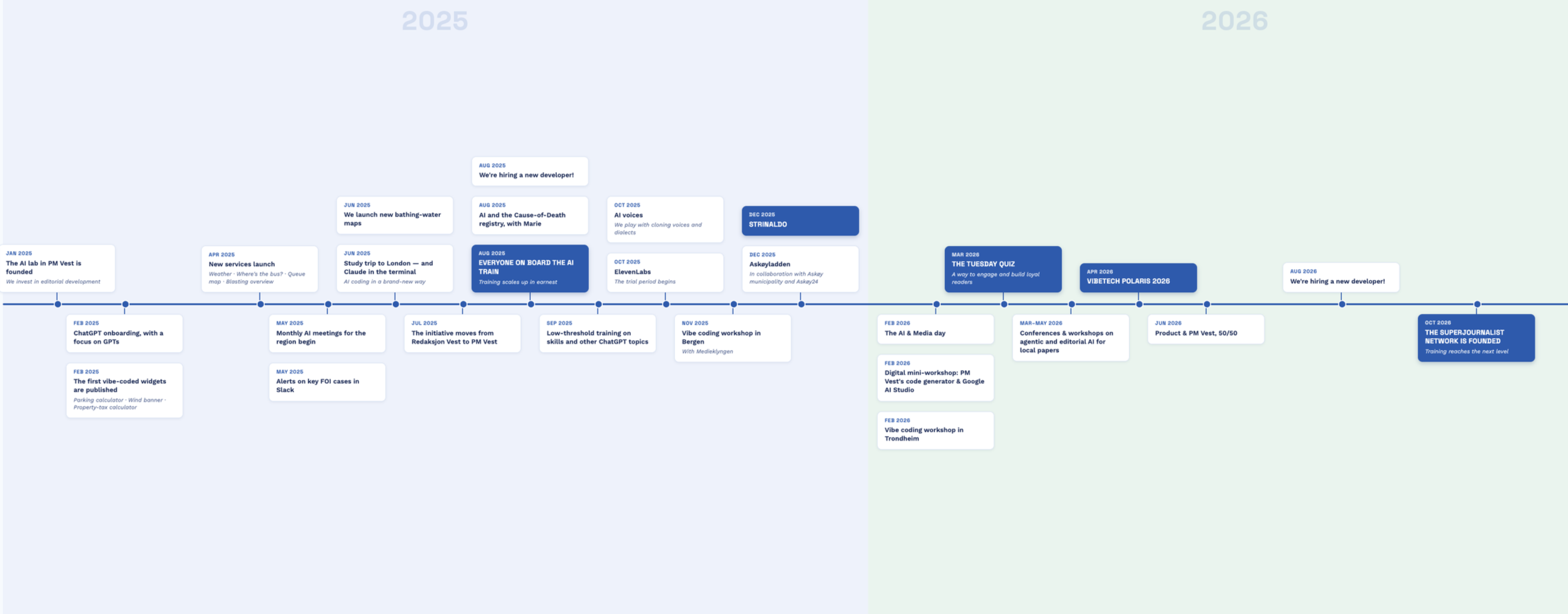
PM Vest AI Journey Timeline
AI- driven Tools & Features Built at Polaris Vest
Parking fee calculator — first AI-assisted widget, built in ~20–30 minutes using ChatGPT to generate code.
Traffic services — most visited pages in local newspapers; include live traffic maps, webcams, live journalist reporting, and a live bus tracker with delay indicators.
Swimming spot map — shows local swim locations, water quality, and live water temperatures; shared openly with other publishers.
Hazard alerts integrated into weather services.
Slack alerts for local emergencies and traffic updates.
Data journalism widgets — e.g., kindergarten happiness data visualisation, school closure risk maps with interactive reader-facing explainers.
A custom vibe-coding GPT that guides journalists through building static HTML widgets with brand styling, without needing to know how to code.
Case Study: World Cup Voting Game
During Norway's World Cup run, journalists wanted a reader voting game integrated into newspapers.
Using a pre-built framework and a single prompt, Kaja Distad turned a journalist-created prototype into a deployable service in ~2 hours (first working version in ~15 minutes).
The game was shared across all Norwegian newsrooms; 24 newspapers used it within 2 days, reaching 34,000 users and generating 100,000 clicks/votes.
Key Takeaways
Best innovation happens close to the journalist, the product, and the reader, not in distant centralised teams. Local media's competitive advantage is knowing their readers: AI cannot replicate authentic, hyper-local trust relationships.
Generative AI is a superpower for small newsrooms, enabling them to do what previously only much larger organisations could.
Prioritise hyper-local services and use open public data to serve readers in ways large AI platforms cannot. AI cannot replicate the deep sourcing knowledge, credibility, and trust built over years within a local community.
Train all journalists, not just a few super-users. Allow them to take calculated risks with guardrails rather than waiting for permission.
Journalists who survive AI disruption will have deep topic passion, sourcing knowledge, credibility, and authentic human connection.
Vibe-coding is a key enabler for journalists who can now prototype and collaborate with developers more effectively. The goal isn't to make every journalist a developer, but to narrow the gap between journalism and development skills.