How 21 European News Ventures Became Viable

"Capital Stacks of Journalism" is a study of 21 viable European news ventures covering capital, revenue, growth, sustainability, risk and returns. The interactive report, authored by Peter Erdelyi and Milo Tesselaar, tracks 21 digital-first, independent news outlets launched across Europe roughly between 2008 and 2021 to test whether independent journalism can be a viable business, not just a cause.
Independent journalism in Europe is a challenging business, but a viable one. With modest, patient, largely non-VC funding, a sustained focus on audience revenue, and founders willing to take unconventional risks, outlets across the continent have built substantial businesses generating €2–8 million, some of them genuinely profitable.
Who Founded Them
Modest capital has repeatedly produced sustainable and sometimes highly profitable companies. Journalists or editors founded 19 of the 21 ventures, almost always in groups rather than as solo founders; several began with entire newsrooms walking out together. Four founding patterns emerge:
Escape or defence (4 outlets: 444, Denník N, OKO.press, The Kyiv Independent) — triggered by an ownership change or political pressure, inheriting a newsroom and audience already in place.
The missing institution (9 outlets: CORRECTIV, De Correspondent, Dossier, elDiario.es, Follow the Money, Krautreporter, Mediapart, Recorder, Republik) — built around a kind of journalism or funding model nobody else offered.
The business case (6 outlets: Brief.me, Contexte, Mill Media, Telegram, Will Media, Zetland) — built around a defined audience, product or channel.
The outgrown project (2 outlets: El Orden Mundial, Tsüri) — volunteer publishing that could no longer stay unpaid.
Founders with established reputations generally earned audience trust and investor confidence faster than first-time entrants.
How Much It Took to Launch
Founding capital ranged from €0 (The Kyiv Independent, Mill Media) to €7–8 million (Republik). Roughly a third of the cohort, a "bootstrap wing", launched on under €100,000; a more capitalised wing started around €400,000 and ran up to several million.
Three launch patterns recur: investor/funder-capitalised starts (9 outlets, newsroom hired day one); revenue-as-capital launches (4 outlets, pre-sold subscriptions or crowdfunding doubling as proof of demand); and sweat-and-trickle launches (6 outlets, stitched together from founder loans, underpayment and small grants). Republik combined several of these approaches. Well-capitalised outlets tended to raise follow-on rounds repeatedly; the bootstrapped mostly never raised again, often by choice, to preserve independence.
Where the Money Came From
Institutional venture capital was essentially absent. Only one VC appears across all 21 cap tables, and it arrived as part of a rescue, not a launch. Capital instead came from six recurring sources: individuals with software-industry wealth, media insiders, old industrial/family wealth, mission-driven institutions (usually joining a year or more after launch), crowdfunding, and investors contributing skills or services rather than cash.
Equity funded 14 of 21 ventures, private grants 10, public grants 7, and crowdfunding 6; debt and convertible instruments appeared less often. Investor expectations rarely focused on pure financial return. Primary investor motivations are civic concern, personal trust in the founding journalists, or a desire to safeguard institutional journalism.
The Scale They Reached
Latest-year revenue across the cohort ranges from about €700,000 to €28.1 million, with a median near €4.6 million, making the typical outlet a €2–8 million business, still growing. Staff costs absorb 50–75% of spending, and margins run thin, though several ventures post healthy profits (high-single-digit to mid-teen margins, with a couple higher). Six outlets broke even within their first year; the median time to break even was three years, with a tail stretching to seven or ten.
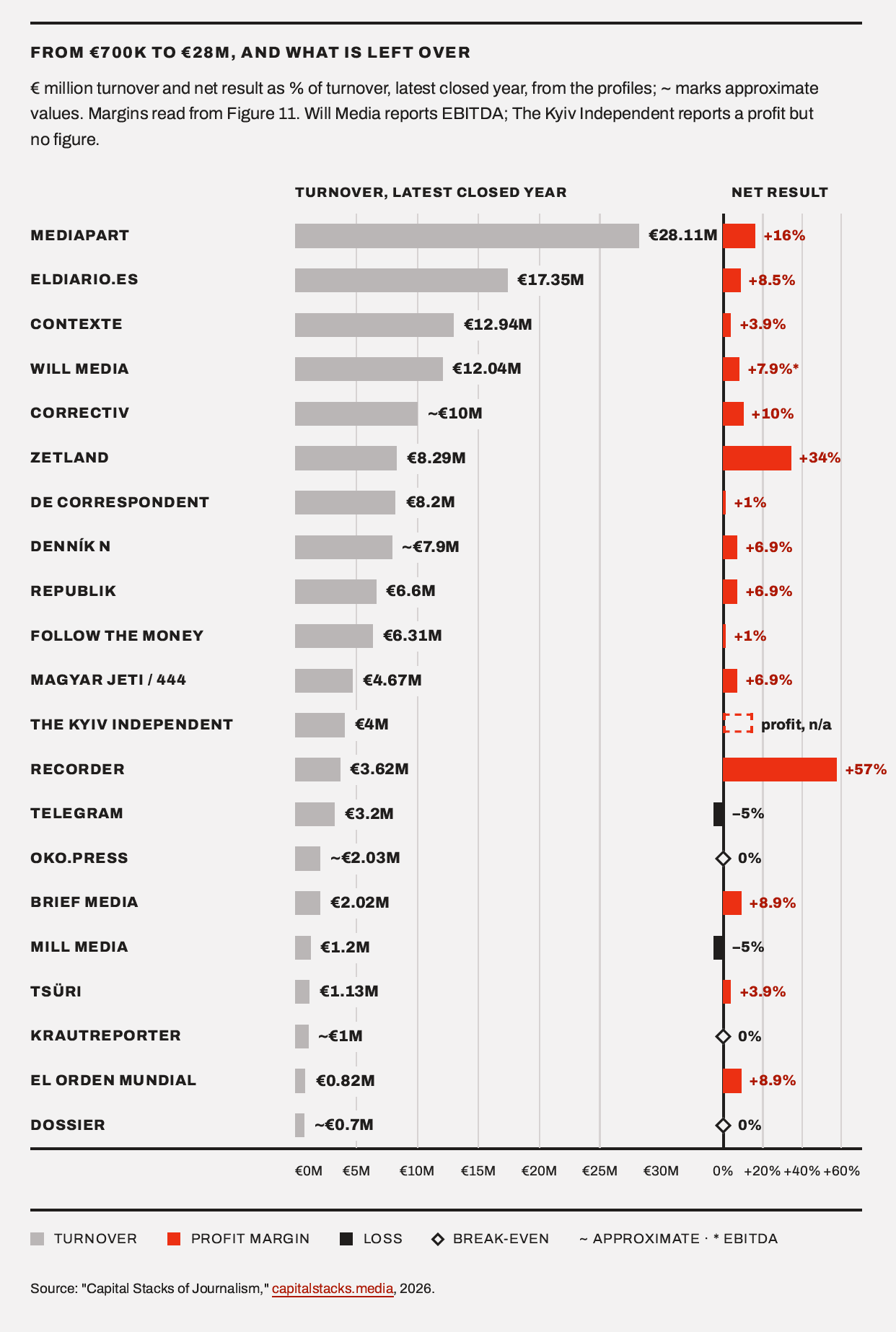
Seventeen of the 21 ventures explicitly identified their technology infrastructure as a direct factor influencing their ability to grow revenue. Over time, the cohort demonstrated a clear operational transition away from custom, self-built IT architectures toward specialised third-party software vendors.
Audience Revenue Still Dominates
Subscriptions and membership are the leading revenue source for nearly the entire cohort, for some outlets, up to 99% of income. Nine outlets run strict paywalls, eight use mixed models, and four stay fully free, but every access-model change observed in the sample moved toward more paywall, not less. Advertising remains a divisive strategic choice but still funds real public-interest journalism for several outlets; books are the most common secondary revenue line.
Grants Help at the Start, Not Forever
At least 10 outlets received platform-development grants — mostly from Google's DNI/GNI programs — usually earmarked for subscription or audience-infrastructure tooling that later helped drive organic revenue growth. Six broad categories of non-commercial funding recur across the sample: philanthropic/foundation grants, platform-development grants, media-development/democracy-promotion grants (NED, EED, EU programs), national press-support subsidies, indirect state support such as tax breaks, and subsidised loans. For most outlets, reliance on grants receded as audience revenue grew.
An Underused Lever: Customer Acquisition
Many of these publishers still can't state their cost to acquire a customer. Where it could be calculated, lifetime value covered acquisition cost three times over or better, and marketing spend stayed in the low single digits of revenue for most of the cohort. Rapid growth spurts tended to coincide with external shocks (a lawsuit, a war, a pandemic) rewarding whichever outlet already had a subscription funnel ready, rather than marketing spend itself.Sustainability as Everyone's Job
As ventures matured, the proportion of editorial headcount relative to total staff declined from nearly 100% at launch to 50–75%. Outlets implemented specific operational mechanisms to distribute financial responsibility across teams:
Incentivised Compensation: Denník N links approximately 5–10% of journalist compensation directly to the subscription conversions generated by their published articles.
Internal Equity Markets: Contexte operates an internal share market for employees, resulting in staff owning approximately 6% of the company.
Cross-Department Integration: Business personnel attend editorial meetings and vice versa; select outlets publish monthly revenue and growth targets directly to all staff.
East and West: Two Different Risk Models
Splitting the sample along the old Austria–Hungary line (15 Western outlets, 6 Central/Eastern) shows similar business fundamentals but very different risk postures:
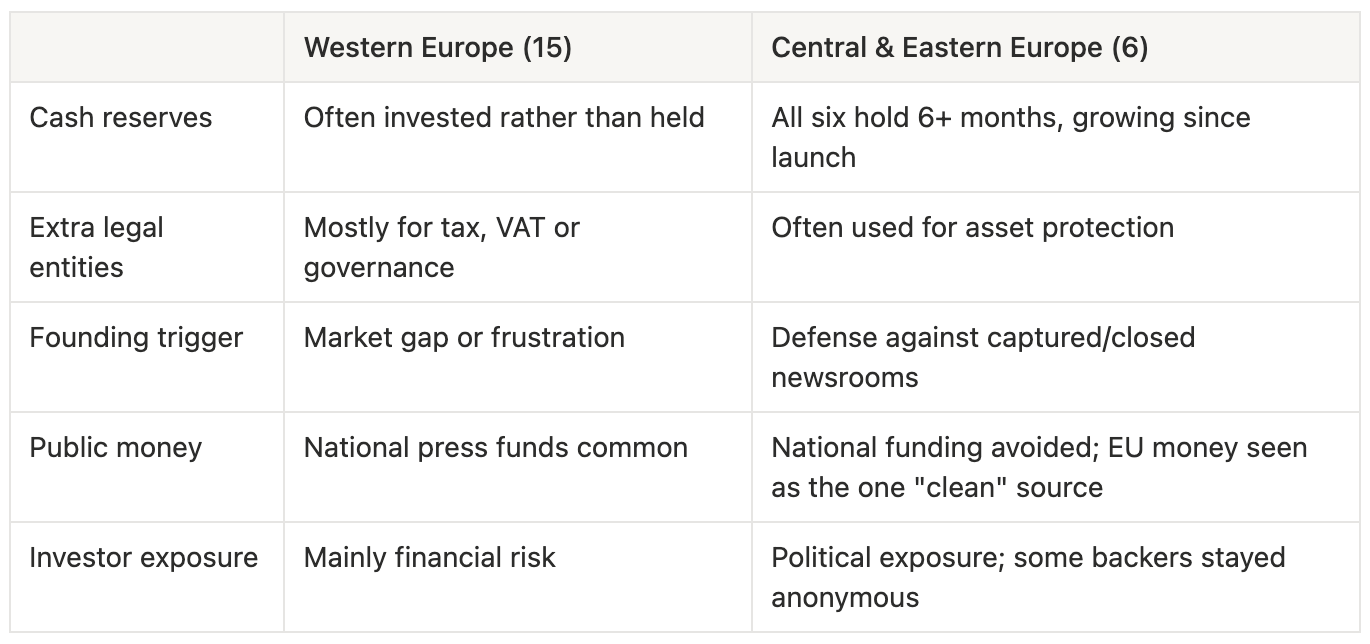
Western Europe (15) Central & Eastern Europe (6) Cash reserves Often invested rather than held All six hold 6+ months, growing since launch Extra legal entities Mostly for tax, VAT or governance Often used for asset protection Founding trigger Market gap or frustration Defense against captured/closed newsrooms Public money National press funds common National funding avoided; EU money seen as the one "clean" source Investor exposure Mainly financial risk Political exposure; some backers stayed anonymous
Mediapart, notably, now holds 12–24 months of reserves in anticipation of a harder political climate — a sign the "Eastern" risk posture may be spreading west.
Modest Returns, Rarely Dividends
Eighteen of the 21 outlets have never paid a dividend; money that did leave the business often went back to the journalists producing the work. Of 16 for-profit entities in the sample, only 4 have ever paid a dividend; the rest of the cohort is split between nonprofits (4) and one cooperative, and several for-profits have contractually committed never to distribute profits. Shareholder exits happened at 15 of 21 outlets, almost always bought back by the company, its founders or employees — only one conventional trade sale occurred (Zetland's majority stake sold to Bonnier News). Where multiples are known, returns cluster modestly: one at roughly 1x, a couple around 1.1–1.5x, a cluster at 3–5x, and two above 5x — no venture-style windfalls, but no venture-style promises either.
Read this as an edited and condensed rewrite of the CapitalStacks.media executive summary plus bits from linked chapter pages. The full report and executive summary are available here: CapitalStacks.media